In ship repair projects, one of the biggest economic and operational risks is not the work itself, but technical uncertainty. When a vessel enters dry-dock with an incomplete scope definition, “surprises” become predictable: unplanned steel renewal, missing materials, decisions made under time pressure, and a schedule that starts to slip.
Pre-docking exists to avoid exactly that scenario. It is not an “extra step”, but an engineering tool to turn uncertainty into data and enter dry-docking with the scope defined, budgeted and coordinated.
What is pre-docking?
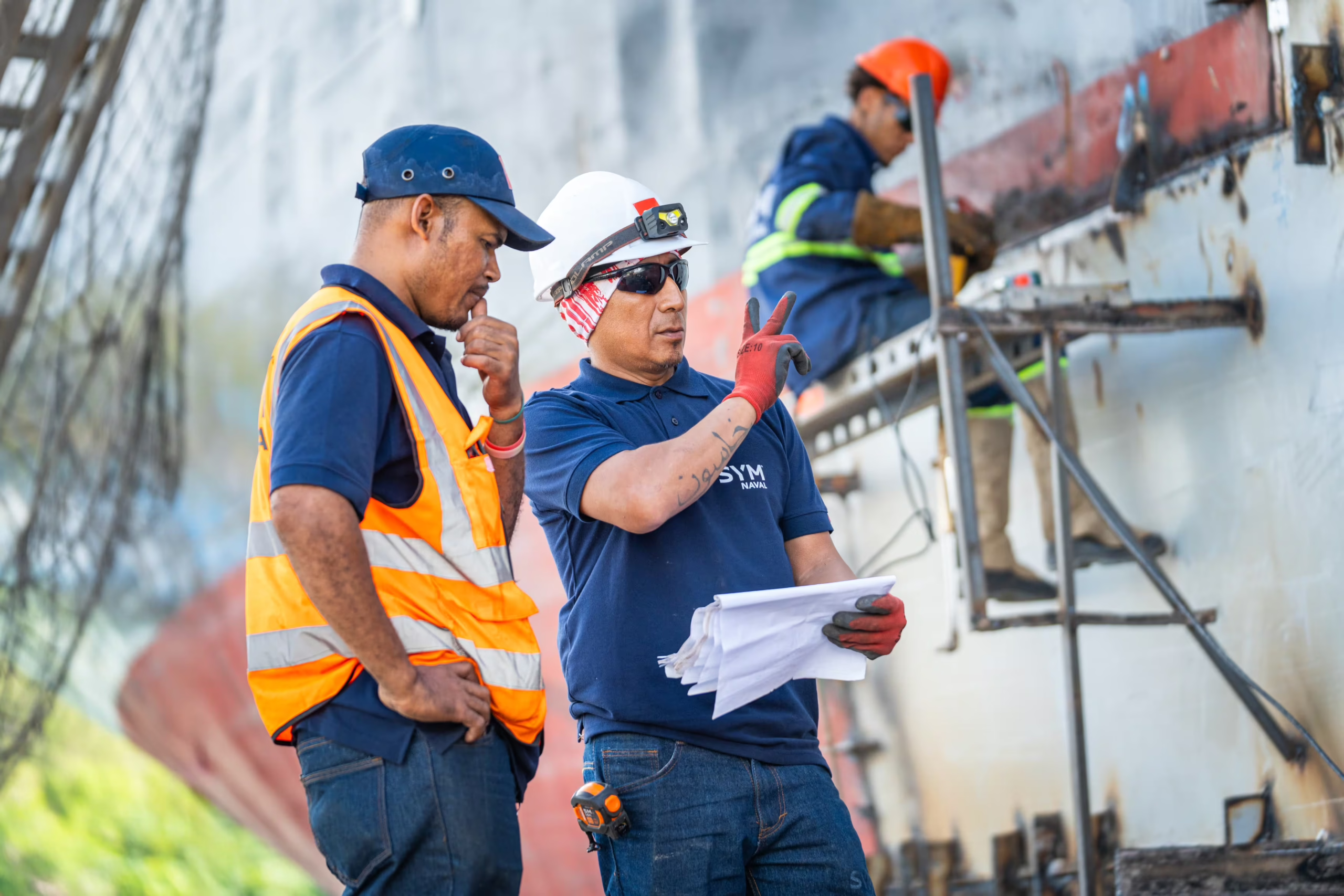
Pre-docking is a thorough technical inspection carried out before the vessel enters dry-dock. Depending on the operational profile and available window, it can be performed in navigation, alongside, or at anchorage. The goal is straightforward: lock the real scope ahead of the docking period to plan the project with precision.
Instead of discovering issues once the vessel is already in dock—when every hour matters—pre-docking enables earlier decisions, better procurement and fewer change orders.
What a proper pre-docking focuses on
A strong pre-docking is not a superficial check. It focuses on the areas that most often drive cost and schedule deviations during docking:
- Hull condition: thickness measurements, deformation detection and a clear steel scope (renewals, reinforcements or local repairs).
- Critical systems: rudder and stock clearance checks, sea valve diagnostics and verification of components that impact sequencing and planning.
- Surface preparation and coatings: assessment of hull condition to define the preparation and paint scheme (blasting, system, coats and real consumption).
The value is in moving from estimates to technical definition: what will be done, how much, with which means, and in what sequence.
The outcome: a locked scope and a controlled docking period
When engineering arrives late, execution pays the price. A well-defined scope before dry-dock allows the project to run under control from day one:
- More robust budgets, with fewer variations driven by uncertainty.
- Earlier procurement coordination for materials and spares (avoiding “emergency buying”).
- Realistic planning for manpower, sequences and critical windows.
- Protection of the vessel’s sailing date, reducing delays caused by unplanned work.
In a high-pressure operational environment, the differentiator is not “reacting fast” inside the dock. The differentiator is arriving with decisions already made.
How it fits within SYM Naval’s approach
At SYM Naval, we integrate pre-docking as part of project planning for ship repair and ship conversion, tailoring the approach to each vessel’s situation: pre-docking checks in port, support in navigation, or technical assistance when the vessel is afloat under operational constraints.
The objective is the same in every case: reduce uncertainty before docking to protect budget, schedule and availability.
Conclusion
Pre-docking is not an additional cost; it is an investment in certainty. Turning uncertainty into real operational data before docking is the most effective way to avoid overruns and defend the project schedule.
If you have an upcoming dry-docking or you are defining a repair scope, our team can support you with a pre-docking approach adapted to the vessel’s profile: contact SYM Naval.