A vessel operating in the North Sea and one operating in the Caribbean age in completely different ways. This is not an impression — it is a technical fact. The combination of seawater temperatures above 28°C, intense year-round solar radiation, extreme relative humidity and high salinity creates an environment that accelerates virtually every known deterioration mechanism on a ship.
Corrosion advances faster. Coatings last less. Joints between dissimilar metals degrade ahead of schedule. Welds in exposed areas accumulate fatigue that in cold waters would take years longer to manifest. And sacrificial anodes deplete in half the expected time.
For any shipowner operating fleets in the Caribbean, Central America, the Gulf of Mexico or the Panama Canal corridor, understanding these mechanisms is not an academic exercise — it is the difference between a maintenance programme that works and one that is always behind the problems.
This article explains the two most relevant phenomena — thermal fatigue and galvanic corrosion — how they manifest across the vessel’s systems, how to detect them in time, and what prevention and repair measures are effective in this environment.
Why Vessels Operating in the Caribbean Deteriorate Faster
Tropical waters are not simply “warm waters.” They are an aggressive system where multiple factors act simultaneously and reinforce each other.
Seawater temperature in the Caribbean stays between 26°C and 31°C for most of the year, with higher peaks in summer. At these temperatures, the speed of electrochemical reactions driving corrosion doubles or triples compared to cold waters in northern Europe or North America. It is a basic chemistry principle: for every 10°C increase, corrosion rate can rise 30–100% depending on material and conditions.
Caribbean salinity is high and stable — around 35–36 parts per thousand — and the high water temperature increases electrical conductivity, which amplifies galvanic corrosion between dissimilar metals. It is the perfect scenario for any galvanic couple on the vessel to work at maximum speed.
Solar radiation is intense and constant. Exposed decks, the superstructure and any painted surface receive a UV load that degrades coatings far faster than at higher latitudes. Chalking, cracking and blistering appear on shorter cycles.
Relative humidity routinely exceeds 80%, maintaining an almost permanent moisture film on all metallic surfaces, even those not submerged. This humidity, combined with coastal salinity, drives atmospheric corrosion affecting the superstructure, decks, deck equipment and electrical systems.
And biofouling accelerates dramatically. In tropical waters, marine organism growth on the underwater hull is far faster and more diverse than in cold waters, reducing antifouling effectiveness and forcing shorter maintenance intervals.
None of this means operating in the Caribbean is unviable. It means the preventive maintenance programme must be calibrated for this environment — not copied from a manual designed for temperate waters.
Thermal Fatigue: What It Is, Where It Appears and How It Manifests
Thermal fatigue is the progressive deterioration a material or structure undergoes when subjected to repeated heating and cooling cycles. It is not a sudden failure: it is a cumulative process that develops over months or years until it manifests as a crack, a seal failure or a structural defect.
On a vessel operating in the Caribbean, thermal cycles are constant and pronounced. An exposed deck can reach 60–70°C during the day and drop to 25–30°C at night — a 30–40°C range repeating every 24 hours. The metal superstructure absorbs heat during the day while the interior is air-conditioned, creating a thermal gradient across the same plates. Ballast tanks alternate between being full of seawater at 28–30°C and empty with ambient air. And the engine room generates its own operational heat cycle on top of the environmental one.
Where it manifests
Deck and superstructure. Exposed deck plates and welded joints between deck and superstructure are the most affected areas. Daily expansion and contraction cycles work the welds, generating micro-cracks that over time compromise watertightness. On vessels with aluminium superstructure on a steel hull, the problem amplifies because the two metals have different thermal expansion coefficients: aluminium expands nearly twice as much as steel for the same temperature increase.
Ballast tanks. The alternation between full and empty, combined with tropical water temperature, accelerates fatigue in internal stiffener welds and tank coating degradation. The splash zone — where the water level fluctuates — is especially vulnerable.
Piping. Pipe runs carrying fluids at varying temperatures (warm seawater in cooling circuits, steam in tank heating lines) experience differential expansion at support points and at connections with other sections or the structure. If supports don’t allow free movement, stress concentrates at welds and flanges.
Gaskets and seals. Elastomeric materials (flange gaskets, manhole cover seals, valve packing) degrade faster under tropical thermal cycling. Rubber loses elasticity, hardens and ceases to seal properly, generating leaks that initially appear mechanical but are actually the consequence of accumulated thermal stress.
Coatings. Temperature cycles combined with UV radiation accelerate paint ageing. In the Caribbean, a coating that in cold waters would last five years may show visible degradation in three. This is not just cosmetic: a degraded coating stops protecting the steel beneath, and corrosion initiates.
Galvanic Corrosion: The Silent Enemy of Bimetallic Joints
Galvanic corrosion occurs when two metals with different electrochemical potential are in direct contact (or electrically connected) in the presence of an electrolyte — which on a ship is seawater. Under these conditions, the more active metal (anode) corrodes at an accelerated rate to protect the more noble metal (cathode). It is the same principle sacrificial anodes use to protect the hull, but when it occurs unintentionally at a joint between dissimilar materials, the result is destruction, not protection.
In tropical waters, galvanic corrosion intensifies for two reasons. First, higher water temperature increases the electrochemical reaction rate. Second, the greater electrical conductivity of warm water allows galvanic current to flow more easily, extending the corrosion radius — that is, affecting a larger area around the contact point.
Where it appears on the vessel
Steel/aluminium hull-superstructure joints. The classic case. The steel hull and aluminium superstructure form a highly active galvanic couple. If the joint is not properly isolated — with bimetallic transition strips, insulating gaskets or barrier coatings — the aluminium corrodes at an accelerated rate in the contact zone, compromising superstructure structural integrity.
Piping connections with dissimilar materials. A carbon steel line connected to a CuNi (copper-nickel) section or a bronze valve creates a galvanic couple. In tropical seawater, the steel corrosion in the zone adjacent to the joint accelerates notably. This is a frequent situation in repairs where a section is replaced with a different material without adequate isolation precautions.
Sea chests. Sea valves, filters and gratings often have bronze or stainless steel components connected to carbon steel piping. In tropical waters, the galvanic couple between these materials operates at maximum speed.
Propeller and shaft. A bronze propeller on a steel shaft, or a stainless steel propeller in contact with the carbon steel stern frame, generates galvanic corrosion that the vessel’s cathodic protection must compensate. When sacrificial anodes deplete — which in the Caribbean happens faster — the galvanic couple operates unchecked.
Sacrificial anodes. This is particularly relevant: in tropical waters, sacrificial anodes (zinc or aluminium) are consumed at a significantly higher rate than in cold waters. A cathodic protection system designed for temperate waters can be exhausted mid-cycle between dockings, leaving the hull and submerged components unprotected for months.
Impact on the Vessel’s Main Systems
Accelerated deterioration in a tropical environment is not limited to one system. It cuts across the entire vessel.
On the hull, underwater corrosion advances faster, anodes deplete sooner and antifouling degrades on shorter cycles. The result is increased fuel consumption from lost hydrodynamic performance, more frequent class thickness findings and the need to shorten intervals between dockings.
On the structure, deck and superstructure welds accumulate thermal fatigue manifesting as micro-cracks, especially at dissimilar-material joints. Atmospheric corrosion wall loss is more pronounced on exposed surfaces where the coating has failed prematurely.
On piping, internal corrosion of seawater lines accelerates due to fluid temperature. Ballast lines suffer splash-zone corrosion and internal coating degradation. And bimetallic joints — common in cooling circuits — are galvanic corrosion hotspots.
On electrical systems, the combination of extreme humidity and temperature degrades cable insulation, switchboard connections and electronic components. Insulation failures are more frequent and megger testing intervals must be shorter.
On machinery, heat exchangers working with tropical seawater suffer greater fouling and internal corrosion. Elastomeric gaskets and seals harden faster. And cooling systems operate closer to their capacity limit, reducing the safety margin.
Detection: Inspection and NDT in a Tropical Environment
Early detection is the key to preventing these problems becoming emergencies. The inspection approach for a vessel operating in the Caribbean must be more frequent and more targeted than the cold-water standard.
Thickness measurement (UT). Frequency should be higher than usual. Where a UT programme every 3–4 years suffices for most circuits in temperate waters, in the Caribbean it should be reduced to 2–3 years, or even annual for highest-risk zones (ballast tanks, seawater lines, exposed deck plates). Results should be compared with previous measurements to calculate wall-loss rate and predict when class minimum thickness will be reached.
Weld inspection (LP, MP). Welds in thermal stress zones — deck joints, superstructure connections, piping support points — should be inspected with liquid penetrant (LP) or magnetic particle (MP) testing more frequently. The goal is detecting fatigue micro-cracks before they become through-cracks.
Visual coating inspection. Chalking, cracking and blistering are the three main degradation indicators in a tropical environment. Systematic visual inspection of topsides, decks and superstructure identifies areas where the coating has lost its protective function, enabling touch-up or renewal before substrate corrosion advances.
Sacrificial anode monitoring. Anode wear is a direct indicator of galvanic activity level on the hull. If anodes deplete faster than expected, it is a clear signal that cathodic protection is undersized for operating conditions or that an uncontrolled galvanic problem exists.
Piping assessment focused on bimetallic joints. Every point in the piping circuit where two different materials connect should be considered a priority inspection point. Thickness measurement in the zone adjacent to the joint and visual inspection of the galvanic isolation (if present) are the basic tools.
At SYM Naval, inspection planning and NDT are adapted to the vessel’s operating environment. The same programme is not applied to a vessel sailing the Baltic and one operating between Santo Domingo, Cartagena and the Panama Canal. HSE procedures and QA/QC ensure that every inspection produces traceable documentation feeding the shipowner’s decisions.
Prevention and Treatment: Making the Vessel Last Longer
Preventing thermal fatigue and galvanic corrosion in the Caribbean does not require exotic technology. It requires technical judgement applied to repair design, material selection and maintenance planning.
Correct material selection in repairs. When replacing a piping section, hull plate or structural component, material choice cannot be driven solely by availability or cost. Galvanic compatibility with adjacent materials must be considered. Introducing a new material that forms an active galvanic couple with the existing one is creating a future problem. SYM Naval’s welders and technicians, qualified by major class societies, work to specifications that account for this compatibility.
Cathodic protection sized for tropical waters. The sacrificial anode system must be designed assuming a higher consumption rate than standard. This means more anodes, higher-mass anodes or, in some cases, impressed current cathodic protection (ICCP) systems that adjust automatically to demand. At every beaching at the Dominican Republic shipyard, SYM Naval evaluates anode condition and resizes the system if findings warrant it.
Coatings adapted to the environment. Not all paint systems deliver the same performance in the tropics. Coatings for the underwater hull, topsides and tanks must be selected considering UV resistance, thermal resistance, osmotic pressure resistance and substrate compatibility. The article on antifouling explores this in depth for the underwater hull. At SYM Naval, surface preparation and coatings are applied using certified solutions adapted to the vessel’s operating environment.
Electrical isolation between dissimilar metals. At every joint where two different metals meet — especially in piping and structural connections — there must be isolation preventing galvanic current flow: insulating flanges, non-conductive gaskets, bimetallic transition strips or barrier coatings. Verifying the condition of these isolations should be part of the periodic inspection programme.
Adapted inspection frequency. The single most important point in the entire prevention strategy: do not apply inspection intervals designed for cold waters to a vessel operating in the Caribbean. This applies to thickness measurement, anode inspection, coating assessment and electrical insulation testing. Shortening intervals slightly increases inspection cost but dramatically reduces corrective repair cost.
Repairing in the Caribbean: Logistic and Technical Advantage
Problems arising from thermal fatigue and galvanic corrosion don’t wait for the vessel to reach a yard in Europe or the Gulf. They develop in the Caribbean and should be resolved in the Caribbean — or as close to the problem as possible.
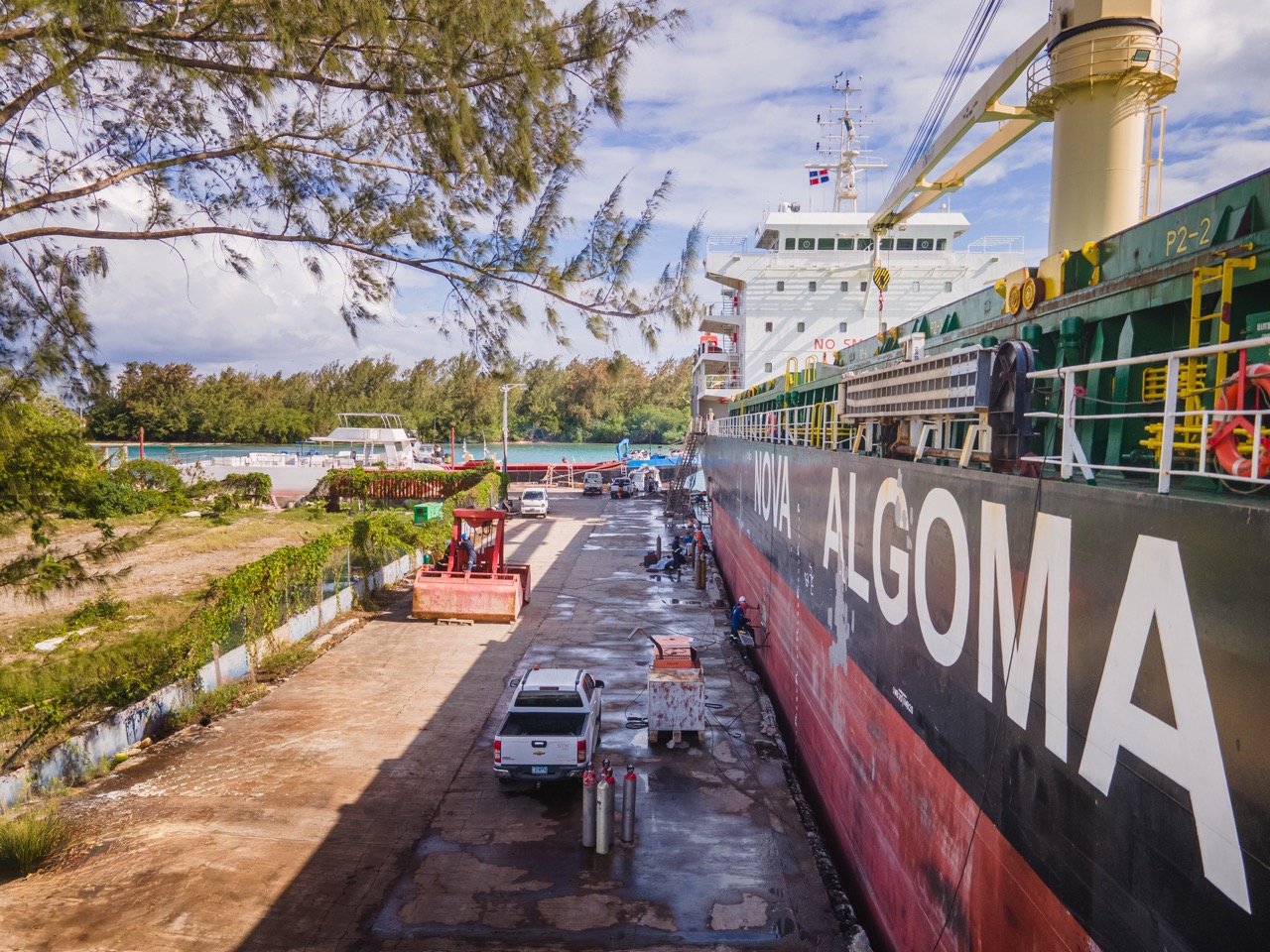
Operating a shipyard in the region has direct advantages for the shipowner. SYM Naval’s base in Boca Chica (Dominican Republic) is 20 minutes from the international airport and directly connected to the Port of Caucedo, simplifying logistics for inspectors, technicians, spares and materials. The beaching apron of over 20,000 m², with capacity for vessels up to 130 metres LOA, enables underwater hull inspection and treatment without diverting the vessel to distant yards.
For work not requiring the vessel out of the water — replacing corroded piping sections, repairing fatigue-cracked welds, renewing topside coatings, overhauling electrical systems — afloat repairs at the Caucedo berth or at the vessel’s port of call are the most efficient option.
And for vessels transiting the Panama Canal, anchorage time is an opportunity to carry out maintenance that would otherwise consume days of off-hire.
SYM Naval’s technical team in the Caribbean works with these problems daily. Repairing a tropical vessel from a yard that has never seen 30°C water is not the same as doing it from one that operates in that environment every day of the year. Environmental knowledge — which materials work, which coatings hold up, where corrosion attacks first — is a technical asset only acquired through local operational experience.
FAQ — Frequently Asked Questions
At what seawater temperature does corrosion accelerate significantly? There is no exact threshold, but as a general reference, for every 10°C increase above “temperate” conditions (15–18°C), corrosion rate can rise 30–100%. In the Caribbean, with water temperatures of 26–31°C, acceleration versus northern European waters is considerable — in the order of 2 to 3 times faster under equivalent material and exposure conditions.
How do I know if my sacrificial anodes are properly sized for the tropics? Inspection during beaching is the key moment. If anodes are 80–90% or more consumed upon arrival, the system is undersized for operating conditions. Accelerated wear may also indicate an uncontrolled galvanic couple somewhere on the hull or appendages. Resizing must consider water temperature, salinity and the expected interval between dockings.
Can thermal fatigue affect new welds made during a repair? Yes, if the repair doesn’t account for the operating environment. A weld in a thermal stress zone (exposed deck, bimetallic joint, rigid piping support) must be designed and executed considering the expansion cycles it will endure. This may involve expansion joints, sliding supports, appropriate material transitions or post-weld heat treatment.
How often should bimetallic piping joints be inspected? At minimum, each time a thickness measurement campaign is carried out. Zones adjacent to joints between dissimilar materials (steel/CuNi, steel/bronze, steel/stainless) should be priority inspection points. For vessels permanently operating in the Caribbean, annual review of the most critical joints is reasonable practice.
Can I use the same coatings as in temperate waters? Technically yes, but performance will be lower and service life shorter. For Caribbean operation, it is advisable to select paint systems with higher UV resistance (topsides and superstructure), higher thermal resistance (exposed decks and tanks) and antifoulings specifically formulated for warm tropical waters, where biological pressure is far greater.
Is it worth repairing these problems in the Caribbean instead of waiting for the regular yard? In most cases, yes. Diverting a vessel to a distant yard to resolve a problem generated in the tropics means days of unproductive sailing, fuel cost and off-hire that can be avoided by repairing in the region. The availability of a yard with European standards in the Caribbean — such as SYM Naval’s in the Dominican Republic — allows resolving these problems where they occur, with the same quality and documentary traceability.
Does your vessel operate in the Caribbean and need a technical assessment?
At SYM Naval we know the specific problems of the tropical environment because we operate in it every day. We assess structures, piping, coatings and cathodic protection with NDT and QA/QC documentation to class standards. From our shipyard in the Dominican Republic, with coverage across the Caribbean and the Panama Canal.
→ Contact our technical team → Visit our Caribbean facilities → Ship repair services