A vessel under repair is one of the most complex working environments in any industry. Hot work alongside tanks that held fuel, confined space operations without natural ventilation, work at height over water, isolation of live electrical and hydraulic systems — all happening simultaneously in a confined space. Sometimes the vessel is underway or anchored far from any shore-based emergency service.
In this context, safety management is not a bureaucratic add-on to the repair project. It is the framework that allows work to proceed without incidents, unplanned stoppages or legal consequences. And for any shipowner contracting a repair, the contractor’s HSE capability should be a selection criterion, not a contract annex.
This article explains how safety is managed in practice during a ship repair: what permit systems are used, how hot work and confined space entry are handled, what energy isolation (LOTO) involves, and why certifications like ISO 45001 have a real operational impact.
Why safety in ship repair is not a formality
A shipyard is not a conventional factory. And a vessel under repair is not a building. Conditions change from one day to the next — or one hour to the next — and risks overlap in ways that are not always obvious.
During a typical repair, welders work on structural steel metres from tanks that contained fuel; technicians enter confined spaces to inspect or repair piping while coating crews apply volatile paints nearby; oxy-fuel cutting proceeds on deck while hydrostatic pipe tests run on the deck below; electrical systems are de-energised and reconnected in sequences that must be coordinated to the minute.
When safety fails in this environment, consequences extend well beyond the workplace: work stoppage lasting days or weeks, legal liability for the yard and potentially the shipowner, surging insurance costs, damage to the vessel requiring unplanned additional repairs, and delays generating further off-hire.
For the shipowner evaluating who to trust with a repair, the contractor’s HSE management is a direct indicator of operational maturity. An outfit that manages safety well is likely to manage timescales, quality and documentation well too.
The permit to work system: the foundation
The Permit to Work (PTW) system structures all risk management during a ship repair. It is the mechanism ensuring that before any hazardous task is carried out, the risks have been identified, preventive measures established, and the work formally authorised.
The most common permits in ship repair are the hot work permit, covering any operation generating flame, spark or ignition-capable heat; the confined space entry (CSE) permit, required for access to tanks, double bottoms, cofferdams or any space with restricted ventilation; the work at height permit, applicable when an operative works more than two metres above a surface or over water; and the electrical isolation permit, authorising disconnection and intervention on the vessel’s electrical systems.
The permit cycle is always the same regardless of type: task-specific risk assessment for that job, at that location, at that time; formal application describing the work, crews involved and preventive measures; approval by the safety officer or authorised person; execution under the approved conditions; and closure once complete, verifying the area is left in safe condition.
Bypassing this system — carrying out hot work without a permit, entering a confined space without prior atmosphere testing, or failing to verify electrical isolation before intervention — is the leading cause of serious accidents in the marine sector. The majority of documented incidents in ship repair are linked to permit omission or non-compliance.
Hot work: welding, oxy-fuel cutting and associated risks
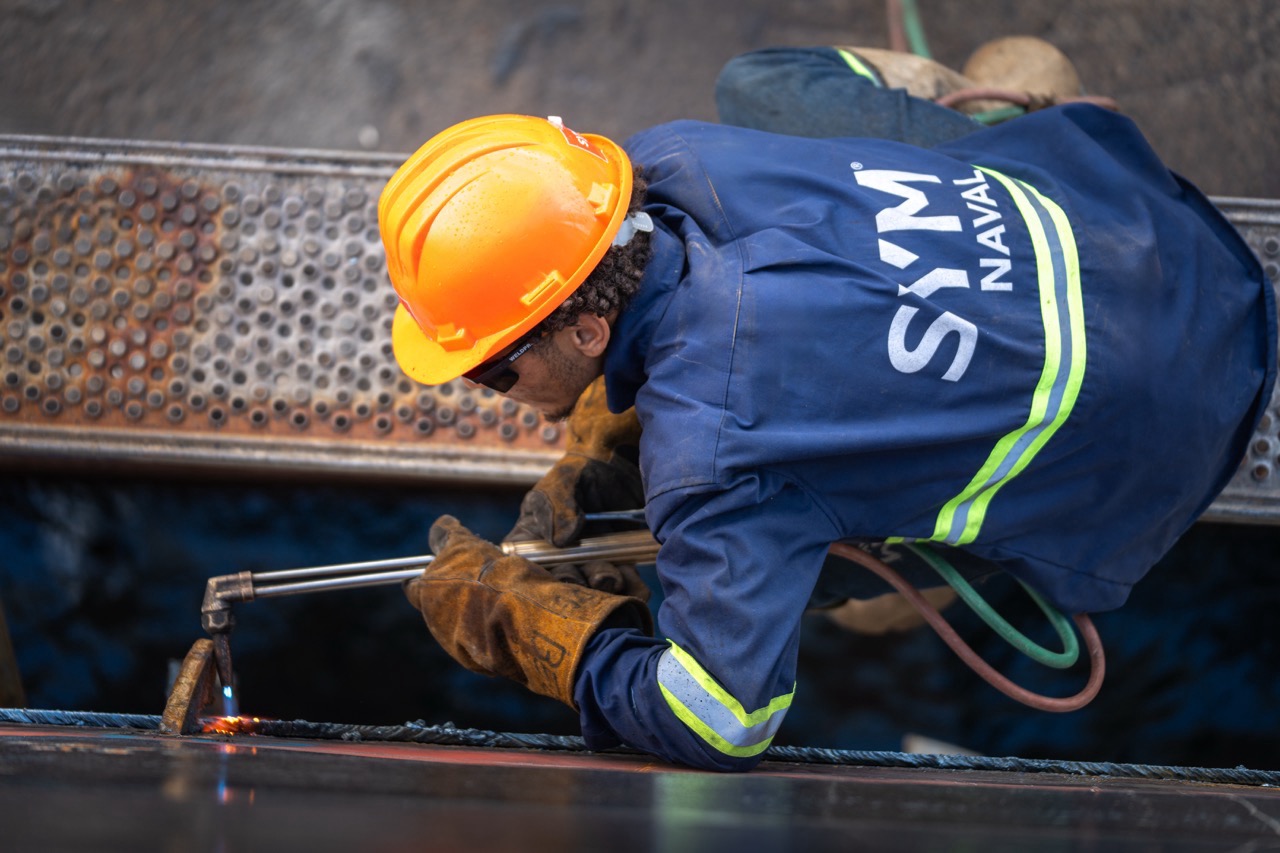
Hot work means any operation producing open flame, spark or sufficient heat to ignite flammable materials. In ship repair, this includes welding (SMAW, MIG, TIG, SAW), oxy-fuel cutting, grinding, disc cutting, and in some cases heat application with a torch for straightening or forming.
The problem is not the operation itself — it is the conditions under which it takes place. A vessel is a container of spaces that have carried or stored flammable substances: fuel in service tanks, oily residues in bilges, accumulated gases in cofferdams, paints and solvents in accommodation areas. Welding two metres from a tank that held fuel oil is not the same as welding in a workshop.
Pre-requisites for hot work on board
Before a welder strikes an arc or an operative connects oxy-fuel equipment, several steps must be completed. First, the work zone and adjacent spaces must be cleaned and degassed. If work is near fuel tanks, these must have been cleaned, ventilated and certified safe for hot work — or, at minimum, appropriate isolation and protection measures established.
Second, atmosphere testing. Oxygen concentration (O₂), lower explosive limit (LEL) and, where applicable, toxic gas levels (H₂S, CO) are measured. These readings are not taken once and considered valid: they must be repeated before each shift and whenever conditions change.
Third, system isolation. Fuel, gas or chemical lines running through the work zone must be locked out and tagged (LOTO). Ventilation systems must be verified. Nearby flammable materials must be removed or protected with fire blankets.
Fourth, fire watch. Every hot work operation requires a dedicated fire watch equipped with an extinguisher and communication means, whose sole function is to monitor the zone during work and for a defined period afterwards (typically at least 30 minutes) to detect delayed ignition.
These requirements are neither optional nor flexible. At SYM Naval, certified hot work procedures are part of the integrated HSE system applied to every intervention, whether in the shipyard, afloat in port or underway with riding squads.
Confined space entry (CSE): procedure and control
A vessel’s confined spaces are arguably the highest-risk environment in ship repair. These include ballast tanks, double bottoms, cofferdams, fuel tanks, fore and aft peaks, chain lockers — any space not designed for continuous human occupation, with restricted access, insufficient natural ventilation and potential for hazardous gas accumulation or oxygen deficiency.
The risks are lethal in the most literal sense. An atmosphere below 19.5% oxygen can cause loss of consciousness within seconds. H₂S (hydrogen sulphide) is fatal at relatively low concentrations. And accumulated flammable gases turn any spark into a potential explosion.
Complete entry procedure
Confined space entry on board follows a strict protocol that admits no shortcuts.
Prior assessment. The space is identified along with its previous contents, specific risks and access conditions. The tank’s history is reviewed: what it contained, when it was last cleaned, whether open connections exist to other spaces.
Forced ventilation. Before any measurements, the space must be mechanically ventilated for sufficient time to completely renew the air volume several times over. Natural ventilation — opening a manhole and waiting — is not adequate.
Atmosphere testing. A minimum of four parameters are measured: oxygen (O₂, between 19.5% and 23.5%), lower explosive limit (LEL, must be 0% or as close as possible), hydrogen sulphide (H₂S) and carbon monoxide (CO). Readings are taken at different levels within the space (top, middle, bottom), because gases stratify by density.
CSE permit. Only when readings confirm a safe atmosphere is the entry permit issued. The permit specifies who enters, for how long, with what protective equipment, who monitors from outside, and what the rescue plan is.
Continuous communication. The person entering maintains permanent contact with the external standby. If communication is lost, the rescue procedure activates.
Continuous monitoring. Atmosphere testing is not a one-off event: it continues throughout the stay. A portable four-gas detector always accompanies the operative. If any parameter deviates, evacuation is immediate.
Rescue plan. Before anyone enters, the rescue plan must be defined, communicated and resourced (rescue harness, tripod, lifeline, self-contained breathing apparatus). An improvised rescue in a confined space typically produces more casualties than the original incident.
This procedure applies every time someone enters a confined space, without exception. At SYM Naval, CSE protocols are part of the certified procedures applied to every intervention.
LOTO (lockout/tagout): energy isolation
LOTO is the procedure ensuring that any energy source capable of endangering workers is effectively isolated, locked and tagged before intervention on equipment or systems.
On a vessel, energy sources are multiple and often interconnected: electrical circuits at various voltages, high-pressure hydraulic systems, pneumatic lines, steam pipes, fuel lines and chemical product lines. An accidental engine start, release of residual hydraulic pressure, or electrical shock from a line believed to be disconnected are real, documented scenarios.
The LOTO sequence is defined: identify all energy sources associated with the equipment or system to be worked on; isolate each source through appropriate means (switch, valve, disconnection); physically lock with a padlock that only the person who placed it can remove; visibly tag identifying who locked, when and why; and verify that energy is effectively isolated (start attempt, voltage measurement, zero-pressure check).
The most common LOTO failure is not technical — it is organisational: assuming “someone already isolated it,” failing to verify zero energy before starting work, or removing a lock without confirming all workers have cleared the zone.
In ship repairs where multiple crews work simultaneously on interconnected systems, LOTO discipline is especially critical. An electrician working on a switchboard while a mechanic reconnects a hydraulic line in the same zone needs both isolations verified and coordinated.
Work at height and over water
Work at height in a marine environment adds a variable absent from conventional construction: water below. A fall from scaffolding in a dry dock has similar consequences to any construction site. A fall from a vessel’s deck when afloat, or from suspended staging over the hull side, can result in drowning.
The most common scenarios are ladder access to tanks and spaces in the topsides, staging erected on the hull side (especially during dry docking or beaching), operations on upper decks and superstructure, and work from platforms over water during afloat repairs.
Specific PPE for these tasks includes a safety harness with twin lanyards, lifelines (horizontal and vertical) anchored to certified points, safety nets where feasible, and a life jacket for any work with a risk of falling into water.
Beyond PPE, what prevents accidents is planning: defining access routes before starting, erecting staging with qualified personnel and verifying stability, establishing exclusion zones below elevated work, and coordinating operations to prevent one crew working above another.
HSE in afloat, underway and at-anchor repairs: additional challenges
When repairs are carried out outside a shipyard — afloat in port, embarked on a vessel underway, or at anchor at a location such as the Panama Canal — safety challenges multiply.
Underway. The vessel is moving. Staging vibrates, tools shift, PPE must withstand sea and wind conditions. Access to external emergency services is zero: if a serious incident occurs, the response must be self-contained until the next port call. This requires the embarked team to carry everything needed: full PPE, atmosphere monitoring equipment, extinguishers, advanced first aid kit, and an emergency plan adapted to the vessel and route.
At anchor. Repairs at anchor — particularly in areas such as Panama or the Caribbean — involve launch access to the vessel, variable weather conditions (extreme heat, sudden storms), coordination with local port authorities and, in many cases, schedules constrained by canal transit windows. Technical teams must arrive with all necessary materials because there is no option to return to the workshop.
Differences from a shore-based yard. In a shipyard, emergency services are minutes away, there is fixed safety infrastructure (evacuation points, muster stations, medical facilities) and environmental conditions are predictable. On board a vessel anchored in the tropics, none of that exists. HSE management must be fully autonomous.
At SYM Naval, mobile teams (riding squads) operate under the same safety protocols applied in the shipyard. Certified procedures for CSE, hot work, LOTO and atmosphere testing travel with the team. Documented quality control (QA/QC) and HSE protocols are integrated into standard operations, aligned with international standards, whether at the Caucedo berth, on a vessel anchored off Colón or on a merchant ship transiting the Caribbean.
The role of certifications: ISO 45001 and its real impact
ISO 45001 (Occupational Health and Safety Management Systems) is not a certificate to hang in reception. It is a management system that requires the company to identify and assess risks systematically, establish documented procedures for every hazardous activity, provide continuous personnel training, investigate incidents and near-misses to prevent recurrence, and undergo periodic audits verifying actual compliance.
For the shipowner, ISO 45001 has a direct practical impact. It demonstrates due diligence: if an incident occurs, the existence of a certified management system is a key argument in legal defence for both shipowner and yard. It is an increasing requirement in vetting and audit processes for major shipping lines, cruise operators and oil companies. And it reduces incident probability, translating into fewer unplanned stoppages, lower insurance costs and fewer delays.
SYM Naval holds ISO 45001 certification, complemented by ISO 9001 (quality) and ISO 14001 (environment) as an integrated management system. This means safety is not a separate department watching from outside: it is woven into the planning, execution and close-out of every project.
The combination of all three certifications reflects an approach where quality, safety and environment are managed as parts of the same system rather than independent compartments. For the shipowner, this translates into a single counterpart with a coherent standard, not three disconnected procedures.
FAQ — frequently asked questions about ship repair safety
Who is responsible for safety during a repair on board? Responsibility is shared but structured. The yard or contractor executing the work is responsible for its personnel’s HSE management: PPE, work permits, procedures and training. The shipowner or their representative is responsible for providing vessel conditions (degassing, system isolation, safe access) and coordinating with class and authorities. In practice, the key is a pre-work safety meeting (toolbox talk) where both parties agree responsibilities, procedures and points of contact.
What work permits are mandatory in a ship repair? Depends on the work, but the most common are the hot work permit (any welding, cutting or grinding), the confined space entry permit (tanks, double bottom, cofferdams), the work at height permit and the electrical isolation permit. Each requires a specific risk assessment, preventive measures and authorisation before work begins.
Can welding be done in a fuel tank? Yes, but only under very strict conditions. The tank must have been cleaned, ventilated, degassed and certified safe for hot work (gas-free certificate). The atmosphere must be tested immediately before and continuously during the work. Connections to other tanks and systems must be isolated, and a fire watch must be present throughout the work and after completion. If any of these conditions is not met, work does not proceed.
What certifications should I require from the yard or crew I contract? At minimum, ISO 45001 (occupational health and safety), demonstrating an audited risk management system. Ideally combined with ISO 9001 (quality) and ISO 14001 (environment). Additionally, welders must hold current qualifications from the vessel’s classification society, and the yard must be able to demonstrate documented procedures for hot work, CSE, LOTO and atmosphere testing.
Does safety slow down repair work? A common perception, but reality is the opposite. A safety incident halts work for hours, days or weeks. The time invested in issuing a work permit, testing an atmosphere or verifying a LOTO isolation is measured in minutes. Well-executed HSE management does not add time to the project — it prevents the stoppages that do.
How is safety managed when the team works underway or at anchor? With the same protocols as in the shipyard, but with greater autonomy. SYM Naval’s riding squads travel with complete atmosphere monitoring equipment, PPE, extinguishers and procedure documentation. Work permits are issued on board following the same forms and criteria as at base. The difference is that emergency response must be self-contained, which makes prevention and prior planning even more critical.
Looking for a ship repair team with real HSE management?
At SYM Naval, every intervention — in the shipyard, afloat, underway or at anchor — is carried out under certified HSE procedures: work permits, CSE, hot work, LOTO and atmosphere testing. We hold ISO 45001, 9001 and 14001 certifications, class-qualified welders and mobile teams available 24/7.
→ Contact our technical team → Explore our ship repair services