Every time a 400-metre container ship approaches a berth, or a bulk carrier positions itself at a terminal, there’s a small vessel doing a job that goes unnoticed but without which the manoeuvre simply cannot be completed: the mooring boat.
Mooring boats collect the lines thrown from the ship, transport them to the bollards ashore and make them fast. It sounds straightforward. But doing it well — quickly, safely, in crosswinds, current and with a vessel of tens of thousands of tonnes just metres away — requires a craft designed specifically for that function.
This article explains what a mooring boat is, how the operation unfolds, what technical requirements the vessel must meet to operate safely and efficiently, and how to design and build one that genuinely resolves the daily demands of a port.
What is a mooring boat and why is it essential?
A mooring boat — also called a line-handling vessel or mooring launch — is a harbour auxiliary craft whose primary function is to assist in the berthing and unberthing of merchant ships, cruise vessels, tankers and any large vessel entering or leaving a port.
Its role is specific and critical: it collects the mooring lines (messenger lines, hawsers and, in some cases, steel wires) deployed from the ship’s deck, transports them to the shore bollards and makes them fast. In the reverse operation — unberthing — the mooring boat helps release lines in a controlled sequence so the vessel can depart safely.
Mooring is one of the highest-risk phases in the entire port operation. Work takes place in direct proximity to a large vessel, with lines under tension that can store enormous energy, in conditions of wind, current and visibility that change by the minute. A failure — a line that parts, a rope fouling the propeller, incorrect positioning alongside the merchant ship’s hull — can have serious consequences for crew, vessel and the ship being assisted.
It is important not to confuse a mooring boat with other harbour craft. It is not a tugboat: the tug controls the ship’s movement by pushing or pulling, while the mooring boat works the lines. It is not a pilot boat: the pilot boards the merchant vessel to direct the manoeuvre, but the mooring boat operates from the water. And it is not a general-purpose support vessel: its design, dimensions, working deck and profile are conceived exclusively for the line-handling function.
That said, in many ports the mooring boat works in direct coordination with tugs, complementing the approach and berthing manoeuvre. It is one piece of the port machinery — but a piece without which the machinery doesn’t work.
How the mooring and unberthing operation works
To understand what should be demanded of a mooring boat, you first need to understand the operation it serves.
Berthing
The manoeuvre begins as the vessel approaches the berth, guided by the harbour pilot and assisted by one or more tugs. As the ship closes in, the merchant crew prepares mooring lines on deck: messenger lines, main hawsers and, in some cases, steel wires for spring or breast lines.
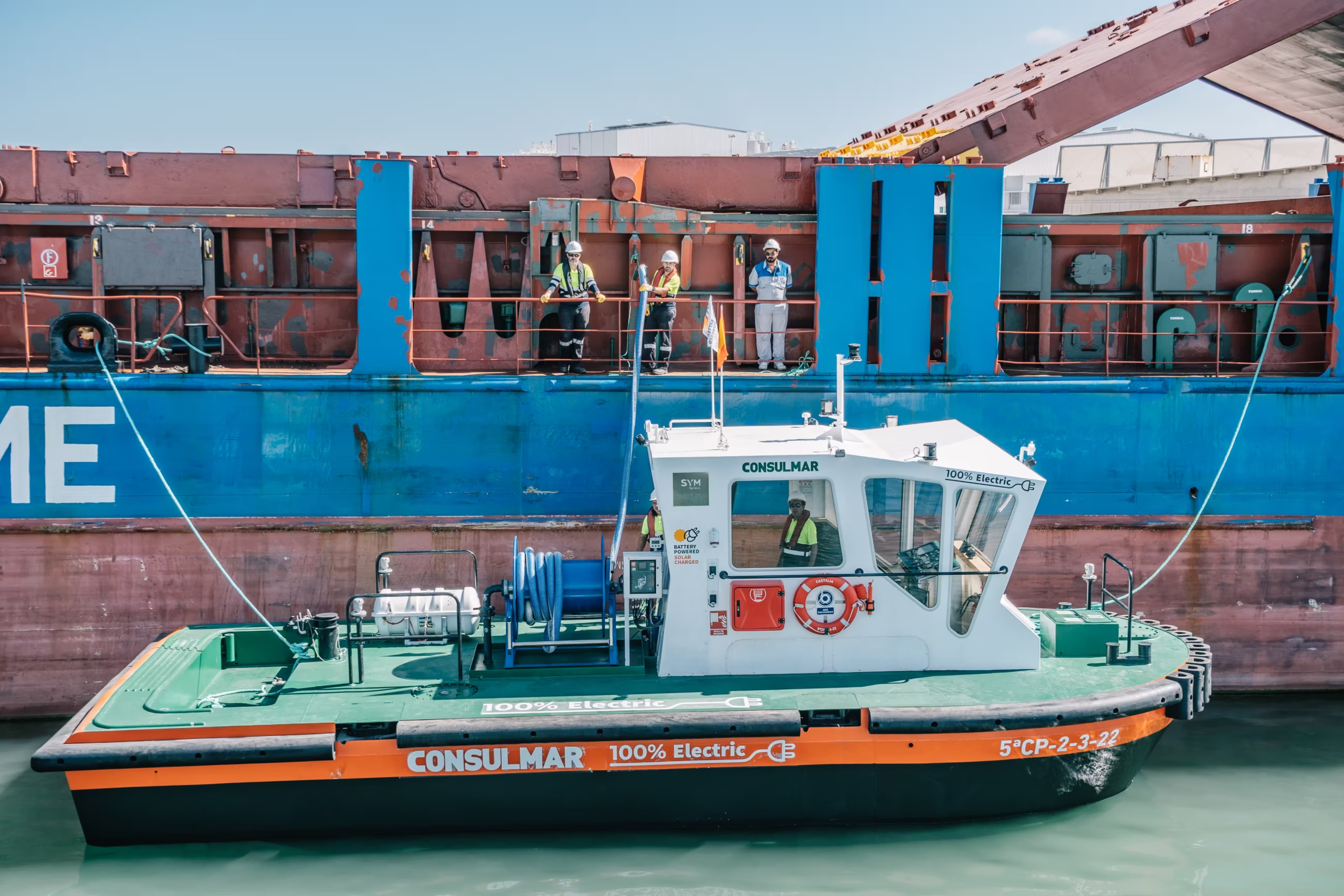
The mooring boat positions itself alongside the ship — typically at the bow and stern, where the first lines are secured. The merchant crew throws a light heaving line that the mooring boat picks up from the water or directly from the ship’s deck. That heaving line is attached to the main hawser, which is the line that will ultimately be made fast on the bollard.
The mooring boat collects the hawser, navigates to the corresponding shore bollard and the boat crew — or linesmen ashore — places the eye over the bollard. This process repeats for every mooring line: breast lines, head and stern lines, springs and any additional restraining lines required.
The sequence and number of lines depend on vessel size, weather conditions and port requirements. A large container ship may need 12, 14 or more lines. Every one of them has passed through the mooring boat.
Unberthing
Unberthing is the reverse operation, but it is not simply “let everything go.” Lines are released in a controlled sequence, coordinated by the pilot and tugs, so the vessel separates from the berth progressively and safely. The mooring boat assists by releasing lines from bollards and, in some cases, ferrying them back to the ship or recovering them from the water.
Real working conditions
Mooring operations don’t always take place in calm seas and good visibility. The mooring boat must operate in crosswinds pushing the ship against the berth or pulling it off unpredictably, in currents affecting both the ship and the boat itself, in residual swell inside the basin (especially in exposed ports), during night operations with limited lighting, and under the time pressure inherent to every manoeuvre.
These conditions define what a good mooring boat must be. It is not enough for it to float and move: it must respond with precision, withstand contact with much larger vessels, protect its crew and remain available shift after shift, day after day.
Technical requirements for a good mooring boat
An efficient mooring boat is not simply a small launch. Every element of its design must respond to a specific operational requirement.
Manoeuvrability. The number-one requirement. The mooring boat works in tight spaces, alongside ship hulls that may tower several metres above the waterline. It needs to change direction rapidly, hold position in wind and current, and move laterally if necessary. This demands a high-response steering system — such as a rudder with high-performance flap — and an appropriate power-to-displacement ratio.
360° visibility. The skipper needs to see in all directions simultaneously: the approaching ship, the target berth, lines in the water, other craft in the basin and their own crew working on deck. The wheelhouse design must guarantee this visibility with no blind spots.
Low superstructure profile. The mooring boat works tight against the ship’s side. If the superstructure is too tall or protrudes laterally, the risk of impact with the merchant ship’s hull, scuppers or mooring lines themselves is significant. The design must integrate the superstructure compactly, minimising height and projections that could snag.
Clear and safe working deck. The crew works on deck handling ropes under tension, on a vessel that is moving. The deck must offer sufficient clear space for line handling, non-slip surfaces, well-positioned mooring bitts and fairleads, and guards preventing falls overboard.
Structural strength. The mooring boat endures frequent contact with ship sides, bollards and quay infrastructure. The hull and fenders must be designed to absorb these impacts without compromising structural integrity or habitability. This means specific reinforcement in the contact zone, fenders sized for the type of ships served, and materials that withstand daily wear.
Speed and agility. The mooring boat must cover the basin quickly — move from one end of the ship to the other, reposition during the manoeuvre, proceed to a second berthing without delay. It doesn’t need cruising speed, but it does need acceleration and low-to-medium-speed handling capability.
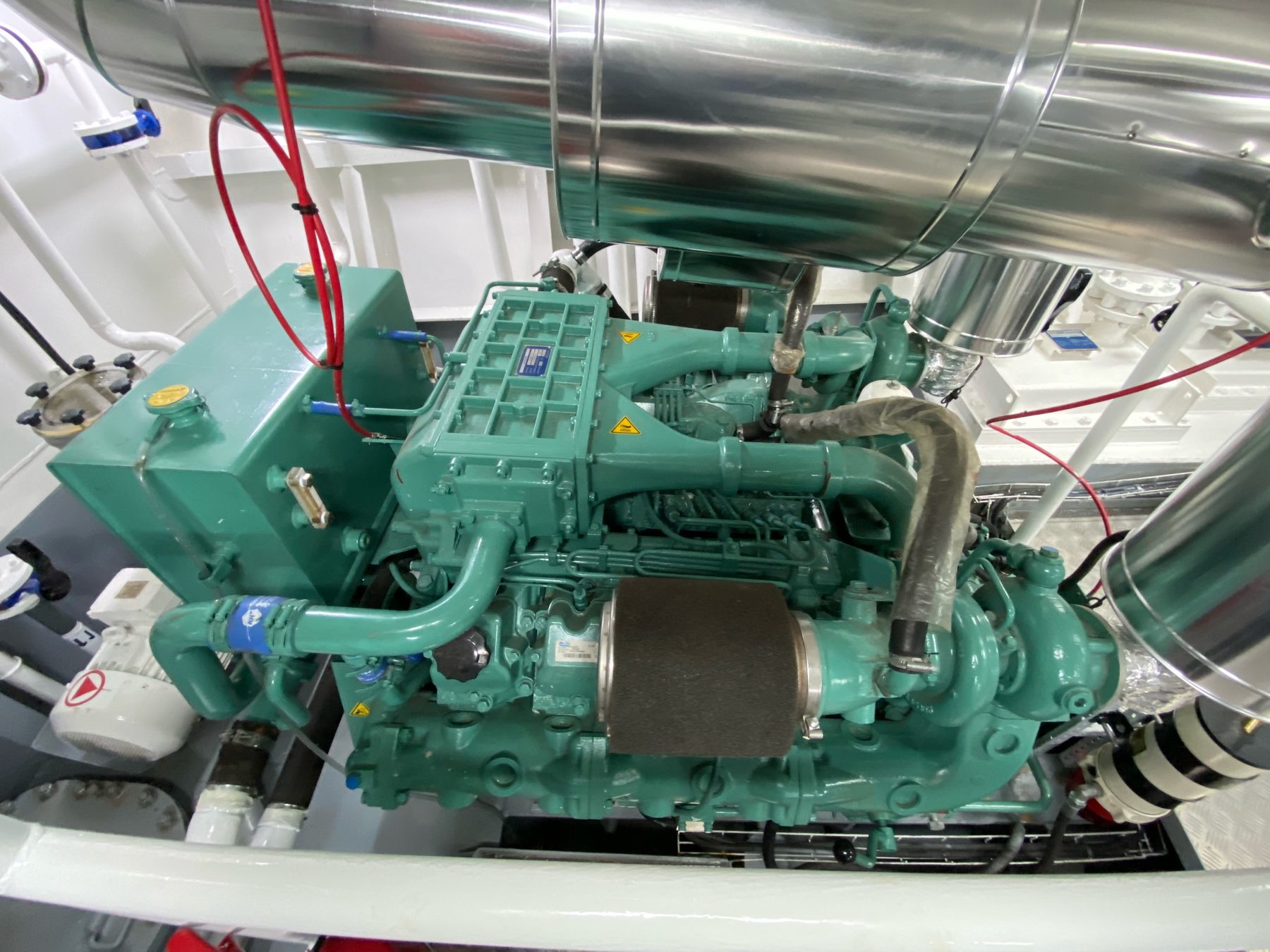
Reliable and maintainable propulsion. A mooring boat that won’t start or needs a week in the workshop is a mooring boat that leaves a port without service. The engine room must be designed for easy access to engines and critical equipment, enabling rapid inspections and preventive maintenance without taking the vessel out of service.
Bollard pull. Although not a tug, the mooring boat needs minimum towing capacity to tension hawsers and wires during the manoeuvre, especially in wind or current. This pull also proves useful when the boat performs auxiliary services such as light towing of barges or buoy positioning.
Design and construction: the SYM Naval approach
At SYM Naval, mooring boats are designed and built using the same methodology applied to tugboats and auxiliary harbour vessels: in-house engineering, custom design tailored to the shipowner’s and port’s needs, and construction to European standards with IACS classification.
The process starts with joint requirements definition with the shipowner or port authority: what vessel types are served, typical wind and current conditions, daily manoeuvre count, shift patterns, and any additional services the boat may need to cover (light towing, anchorage support, personnel transfer).
From there, the engineering office develops the design using a digital mock-up — a complete 3D model that validates dimensions, access, visibility, deck layout and engine room arrangement before fabrication starts. This is especially relevant for a mooring boat, where space is limited and every centimetre counts: wheelhouse position, superstructure height, line runs and bitt placement must all be resolved before the first steel plate is cut.
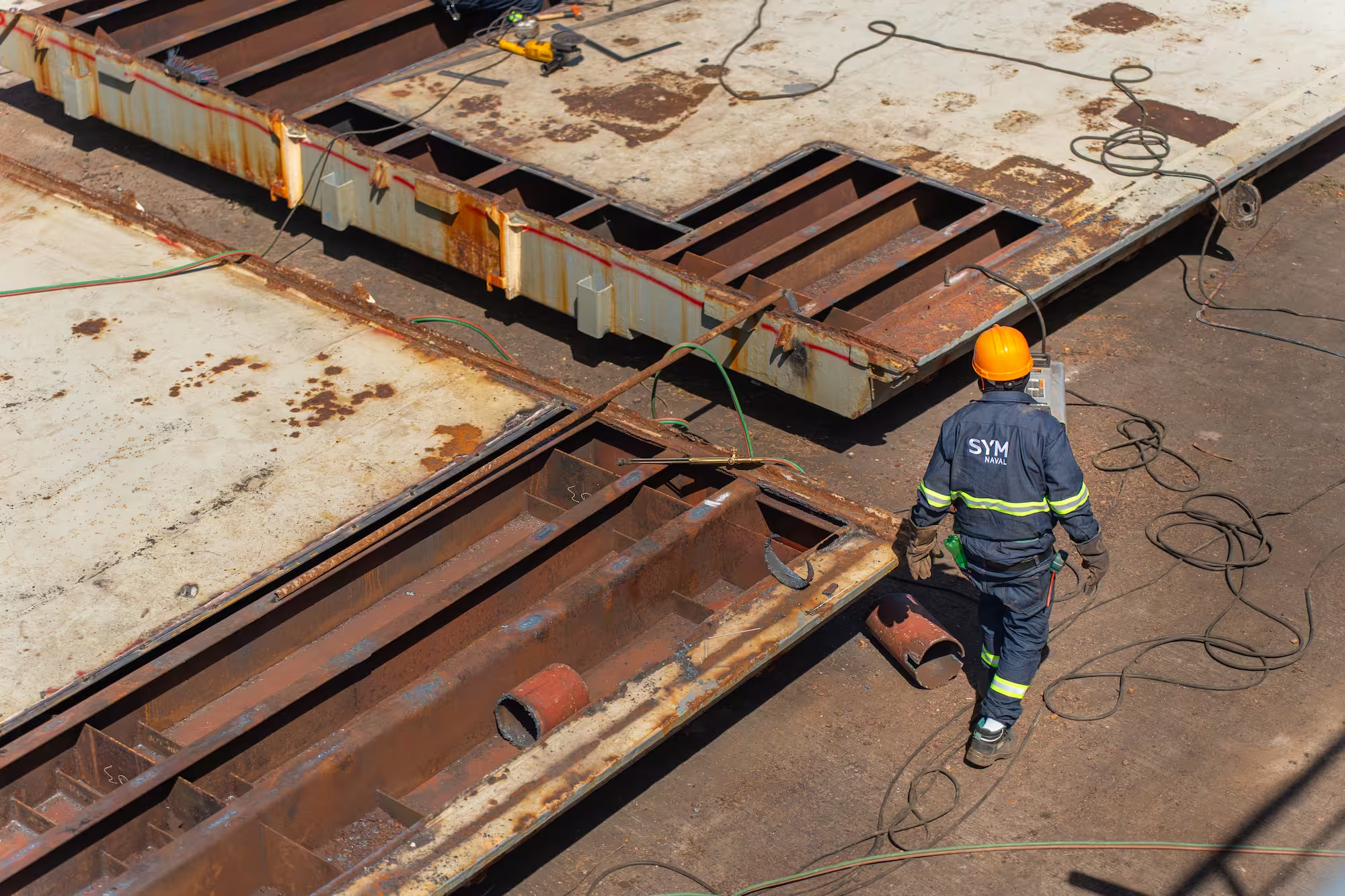
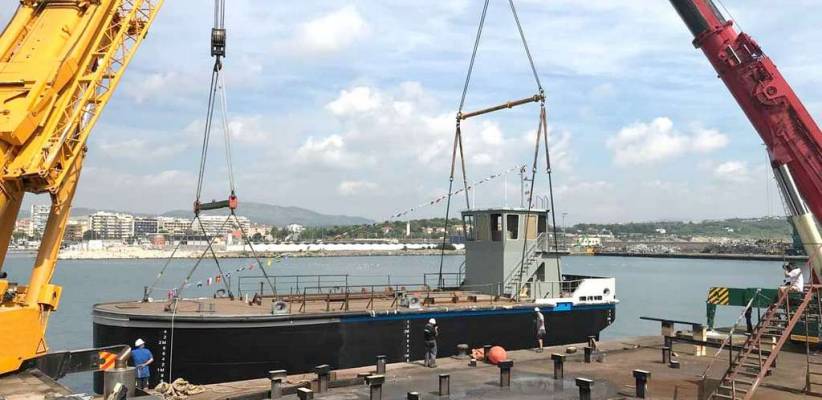
Construction is carried out in steel, with specific reinforcement in contact zones. The steering system features a rudder with high-performance flap to maximise low-speed manoeuvrability. The engine room is designed as an accessible workspace facilitating daily maintenance. And the wheelhouse provides 360° visibility with operator-adapted ergonomics.
For propulsion, SYM Naval offers the three standard options in its harbour vessel range: diesel, hybrid and fully electric, matching the powertrain to the port’s operational profile.
Every unit is delivered classified by an IACS society and ready for flagging in the destination country.
The 2402 mooring boat by SYM Naval
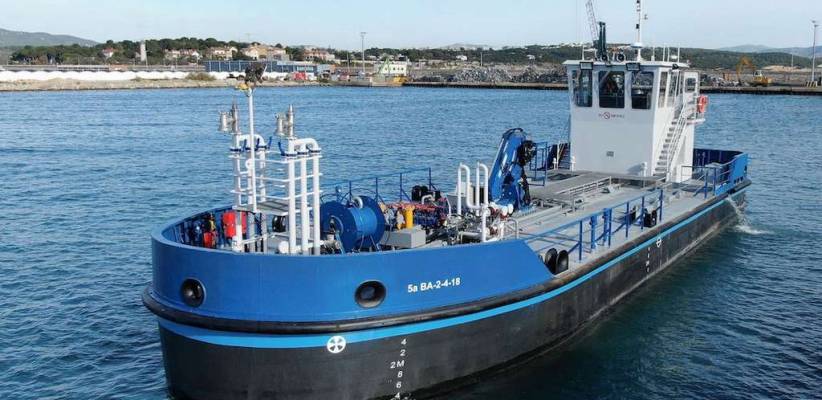
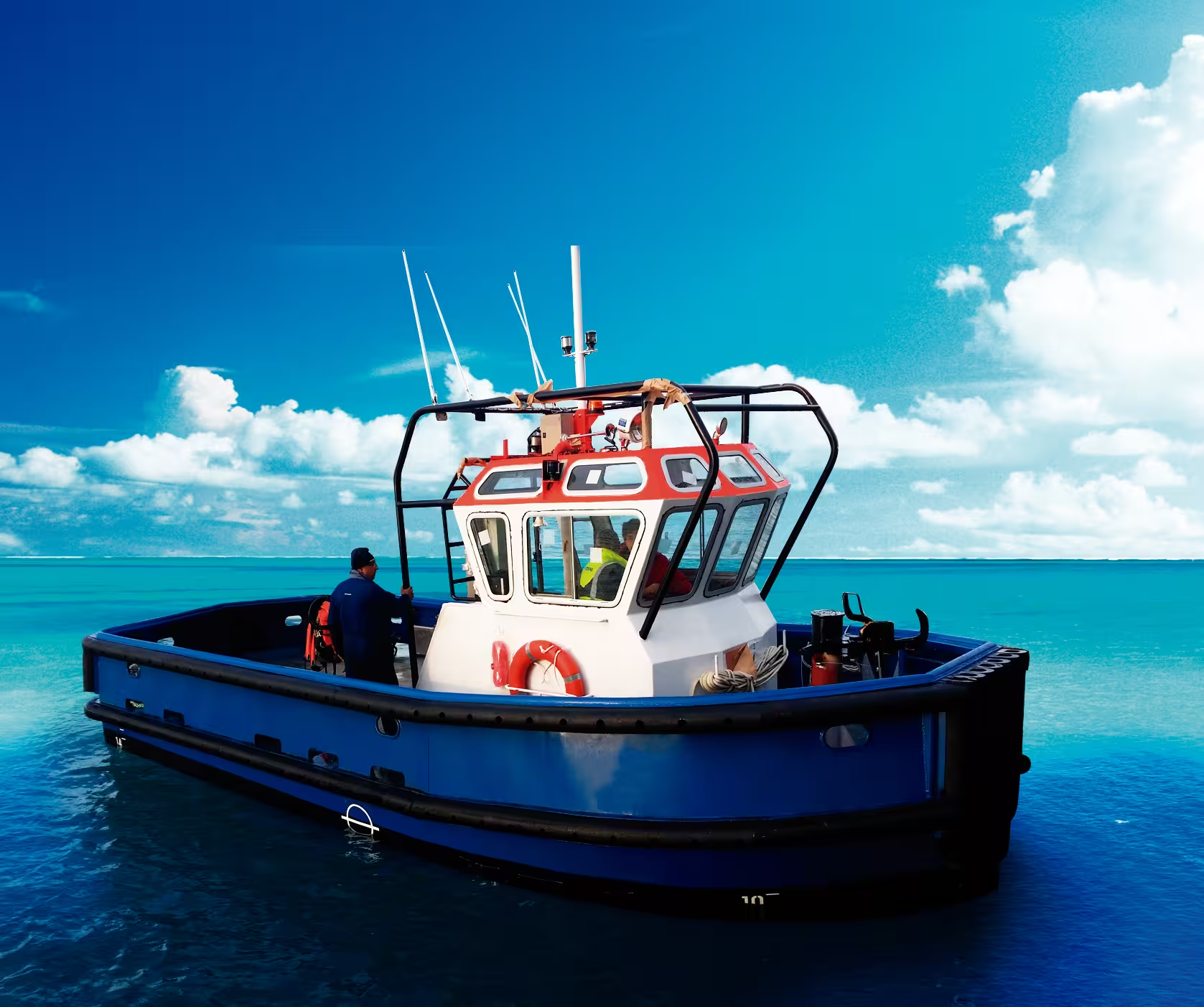
The 2402 Mooring Boat is SYM Naval’s reference model in this category. It is a specialised harbour craft designed to meet the operational demands of shipowners and the regulations of port authorities internationally.
Dimensions. 8.70 metres LOA, 3.60 metres beam and 1.50 metres depth. A compact size that enables operation in the tightest basin spaces without sacrificing stability or working capacity.
Propulsion and steering. 230 HP diesel engine at 2,200 rpm with an 840 mm four-blade fixed-pitch propeller. Steering via rudder with high-performance flap, delivering exceptional low-speed manoeuvrability — exactly what a mooring boat needs in real operations.
Capabilities. 2-tonne bollard pull, 8-knot speed and 1.2 m³ fuel capacity. The bollard pull enables confident line tensioning and light auxiliary towing when required.
Crew. Designed for 2 persons, with a wheelhouse offering full 360° visibility — critical for safety and precision during manoeuvres. The superstructure integrates compactly into the vessel’s design, preventing impacts with assisted ships.
Engine room. Designed to maximise accessibility to engines and key equipment, facilitating the rapid inspection and maintenance vital to the operational continuity of a vessel that works every day of the year.
Mooring boat vs. tugboat: when do you need each?
A common question, particularly for ports sizing or renewing their harbour fleet. The answer is not “one or the other” — it’s “each for its own purpose, and sometimes both together.”
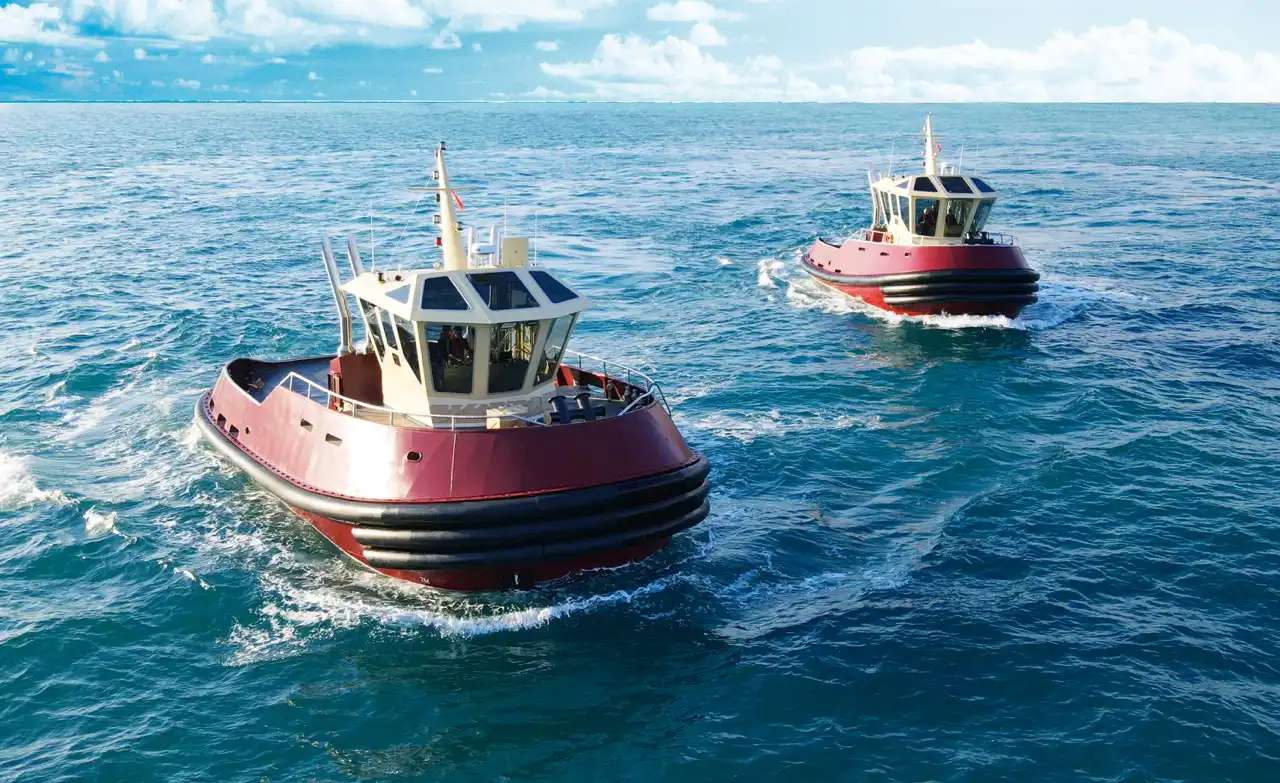
The tug controls the ship’s movement: it pushes, pulls, brakes, positions. It works with the ship’s mass, applying force through towlines or direct contact. Bollard pull ranges from 10–15 tonnes for compact tugs to 80 tonnes or more for high-capacity units.
The mooring boat works the ship’s mooring lines: collecting, transporting and securing them to the berth. It does not control the ship’s movement — it complements the manoeuvre by making it possible for the ship to be secured once positioned.
In large, high-traffic ports, both craft operate simultaneously: tugs position the ship while the mooring boat makes the lines fast. In smaller ports or those with moderate traffic, a multipurpose vessel often combines both functions — integrating bollard pull, a mooring work deck and, in some cases, additional MARPOL capability.
The decision depends on traffic volume, the size of vessels served, the port’s environmental conditions and the operating model. What matters is that each function is covered by a vessel that genuinely delivers — not by a compromise that does neither job well.
Trends: electrification and sustainability
Mooring boats are natural candidates for electrification, and for good reasons. Their operational profile is ideal: short work cycles (each mooring operation lasts 15–45 minutes), frequent return to the home berth (where batteries can charge), operation exclusively within the port area (where emission restrictions are strictest) and relatively low power demand compared to a tug.
The entry into force of the Emission Control Area (ECA) in the Mediterranean and growing pressure from port authorities to reduce in-basin emissions are accelerating this transition. For a port aiming to meet ambitious environmental standards, electrifying the mooring fleet is one of the highest-impact, lowest-complexity measures available.
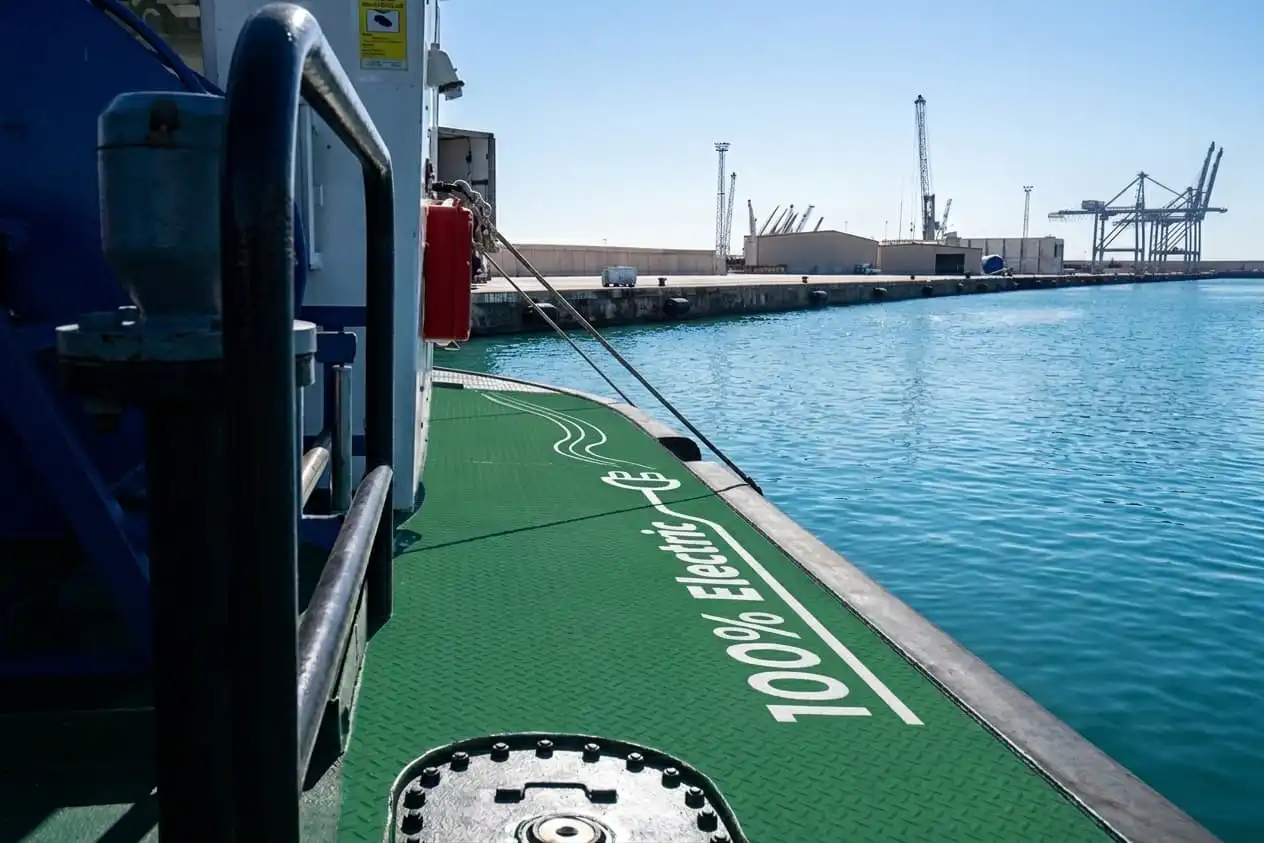
SYM Naval validated fully electric propulsion in real port conditions with the Castalia, the first fully electric harbour vessel developed with in-house engineering and propulsion. That experience applies directly to the mooring boat range: the same energy management systems, batteries and electric motors can be integrated into a mooring boat design, delivering zero direct emissions, drastically reduced noise and lower maintenance costs.
The hybrid (diesel-electric) option provides an intermediate step for ports seeking emission reductions but not yet equipped with quayside charging or needing reserve autonomy for extended shifts.
FAQ — frequently asked questions about mooring boats
What size should a mooring boat be? It depends on the vessels served and port conditions. For standard commercial ports, mooring boats typically range from 8 to 12 metres LOA. What matters is not just length but the combination of manoeuvrability, stability, usable deck space and structural strength.
How many mooring boats does a port need? Depends on daily manoeuvre count, basin size and shift patterns. A port with 10–15 daily manoeuvres may need 2–3 boats to cover shifts and maintain a reserve unit. Larger ports operate fleets of 6, 8 or more.
Can a mooring boat perform tug functions? A standard mooring boat lacks the bollard pull to substitute a tug for positioning large vessels. However, it can perform light towing of barges, pontoons or smaller craft. For ports needing combined functions, multipurpose vessels offer higher pull (8–11 tonnes) alongside a mooring work deck.
Can mooring boats be electrified? Yes, and their operational profile makes them especially suited: short cycles, port-only operation, frequent return to berth for charging. SYM Naval offers diesel, hybrid and fully electric configurations for its harbour vessel range, including mooring boats.
What maintenance does a mooring boat require? Basic maintenance is similar to any workboat: engine, steering, hull (especially contact zones and fenders), electrical and safety equipment. The difference is intensity of use: a mooring boat may operate 12–16 hours daily, 365 days a year. Engine room design must facilitate rapid inspections without taking the vessel out of service.
What certification does a mooring boat need? It must be classified by an IACS member society (DNV, ABS, LR, BV, RINA, NK or others) and comply with flag state regulations for the country of operation. Specific requirements depend on length, service type and the local port authority’s rules.
Need a mooring boat for your port?
At SYM Naval we design and build custom mooring boats with in-house engineering, digital mock-up and diesel, hybrid or fully electric propulsion options. Every unit is tailored to the port’s real operations and delivered classified and ready to work.
→ Contact our team → View our harbour vessel range → Explore our shipbuilding capabilities