A vessel can sail with a dented hull plate. It can operate on a backup generator. But when a critical piping line fails — fuel, ballast, cooling, bilge — operations stop. And every hour of downtime counts against the bottom line.
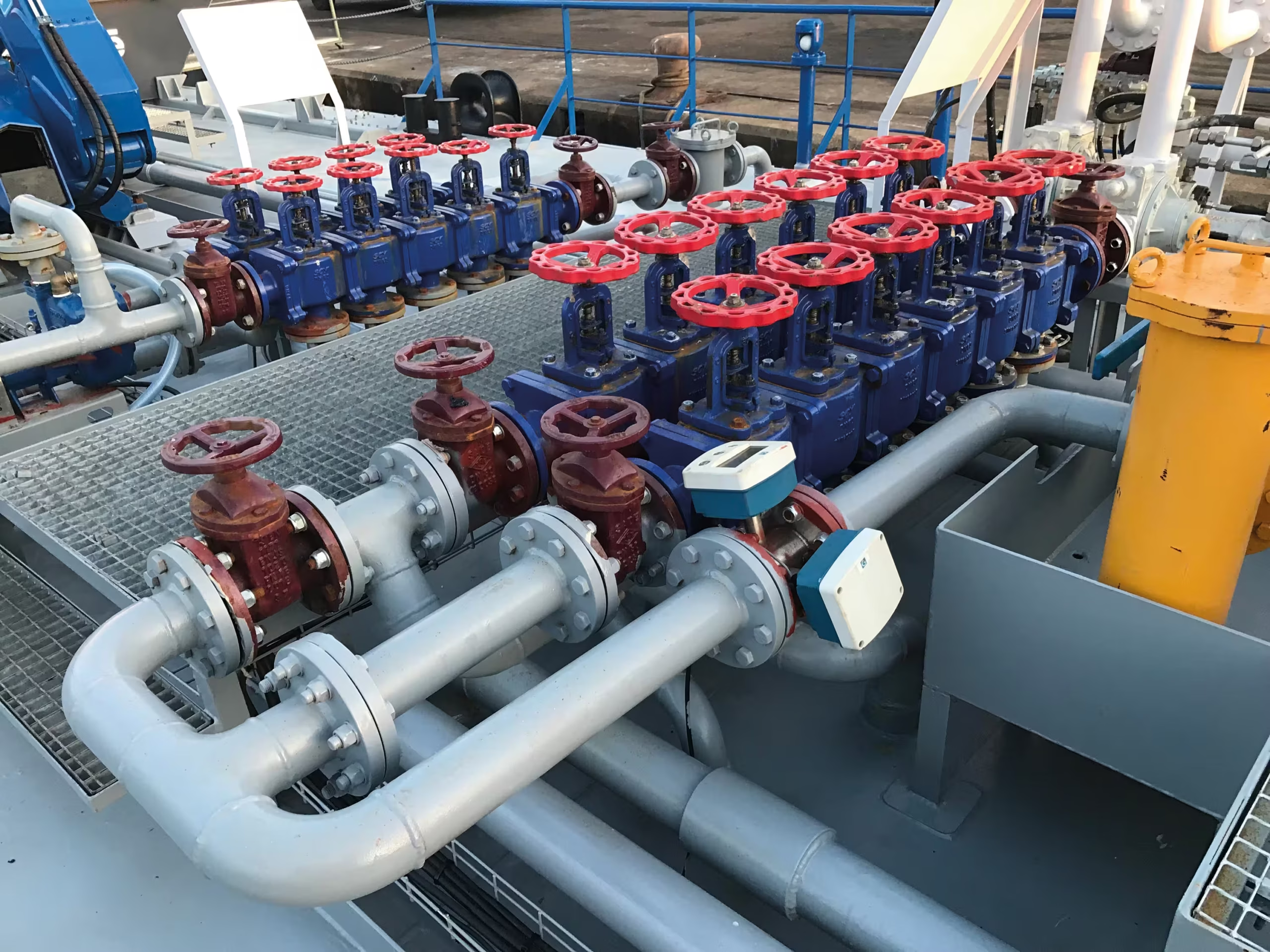
Piping is arguably the most extensive and least visible system on any ship. Kilometres of lines running through tanks, bulkheads, engine rooms and decks, connecting every system that keeps the vessel running. When something fails in those lines, the problem rarely stays contained.
This article covers what’s involved in repairing and maintaining piping on board, which materials are used, how work is carried out to class standards, and how to plan these interventions so the vessel loses as little time as possible.
What ship piping is and why it matters
Ship piping encompasses all pipelines, valves, fittings and supports that distribute fluids throughout the vessel. It is not a standalone system — it is the infrastructure that feeds and connects virtually every system on board.
Key circuits that depend on piping include ballast and deballasting, seawater cooling for engines and auxiliaries, fuel oil supply lines from storage to main and auxiliary engines, bilge and oily water systems, hydraulic circuits for cranes, hatch covers and steering, steam lines for tank heating, and fresh water supply for domestic and technical use.
Two factors make piping critical. First, its sheer extent: a medium-sized cargo vessel may have several kilometres of piping. Second, the operating conditions: these lines carry fluids at varying pressures, temperatures and levels of chemical aggressiveness. A leak in a fuel line and a leak in a freshwater line have very different consequences, but both can lead to operational downtime if not addressed properly.
Common piping failures on board
Most piping failures don’t happen overnight. They develop over months or years and tend to surface at the worst possible time.
Internal and external corrosion. The most frequent cause of deterioration. Internal corrosion results from continuous contact with aggressive fluids — seawater, high-sulphur fuel, acidic condensates. External corrosion, often overlooked, stems from ambient humidity, missing coatings or water pooling from condensation. Bilge and ballast lines are particularly vulnerable.
Erosion. Lines carrying high-velocity fluids or fluids with suspended particles — such as unfiltered seawater — suffer progressive wall thinning, especially at bends, reducers and direction changes.
Vibration fatigue. Engines, propellers and the vessel’s own motion generate constant vibration. Over time, this causes micro-cracking at welds and connections, particularly in rigid lines with poor support or long unsupported spans.
Joint, flange and valve failures. Gaskets lose seal integrity, valves seize or fail to close properly, and flanges can deform from uneven tightening or galvanic corrosion between incompatible materials.
Poor previous repairs. It is not uncommon to find sections where earlier repairs used wrong materials, unqualified welding or no class documentation. These “emergency fixes” that never get properly rectified are a recurring source of problems.
The operational consequences are direct: leaks that contaminate tanks or bilges, auxiliary system shutdowns that reduce the vessel’s operating capacity, environmental non-compliance (especially on bilge and MARPOL lines), class findings that prevent sailing, and ultimately, off-hire.
Materials used in ship piping
Material selection determines the line’s service life, the welding process required, the certifications needed and the cost and complexity of any repair.
Carbon steel. The most widely used material in ship piping. Found in ballast, bilge, fuel and low-pressure systems. Weldable with standard processes (SMAW, GMAW, FCAW), relatively inexpensive and readily available at any port. Its main weakness is corrosion: in contact with seawater or aggressive fluids, it requires internal coatings or sacrificial anodes.
Stainless steel. Used in lines requiring higher corrosion resistance or hygienic standards: potable water, sanitary systems, certain hydraulic lines and high-demand cooling circuits. More expensive, requiring welders qualified in TIG/GTAW, but offering significantly longer service life in aggressive environments.
Copper-nickel (CuNi). The reference material for seawater lines: cooling circuits, fire-fighting systems and ballast lines in exposed areas. The most common shipboard alloys are 90/10 and 70/30. Excellent marine corrosion resistance, but CuNi welding requires specific qualification, controlled atmosphere and class-validated procedures.
Aluminium. Used in superstructures and aluminium-built vessels to maintain structural consistency and prevent galvanic corrosion. Also found in some ventilation lines and lightweight systems. Welding (typically TIG) requires extreme cleanliness and oxidation protection during the process.
What matters to the shipowner is that each material demands a different welding procedure, welders with specific class society qualifications, and traceable material certificates. A piping repair cannot be improvised with whatever is available in the stores: the filler material, the procedure and the welder’s qualification must match the system and be verifiable by the surveyor.
How a piping repair is carried out on board
A piping intervention follows a defined sequence. When it’s respected, it avoids rework and class issues. When steps are skipped — due to urgency, poor planning or lack of expertise — that’s when hidden costs appear.
Inspection and diagnosis
Everything starts with assessing the actual condition of the line. Visual inspection is the first step, but seldom sufficient. Non-destructive testing (NDT) is used to determine the real extent of deterioration: ultrasonic thickness measurement (UT) to quantify remaining wall thickness, radiographic testing (RT) to evaluate existing welds, and in some cases liquid penetrant (LP) or magnetic particle (MP) testing to detect surface cracks.
The inspection results define the scope: which sections to repair, which to replace, and what materials are needed.
Planning to class specifications
Before cutting the first pipe, the work must be technically defined. This means preparing the appropriate welding procedure specification (WPS) for the material and service, verifying that assigned welders hold valid qualifications for that process and material, coordinating class society supervision as required, and ensuring availability of certified materials with documentary traceability.
For complex interventions involving multiple affected sections, prior engineering makes a real difference. Defining the scope with drawings, isometrics and material lists before starting reduces on-the-go changes and shortens execution time.
Fabrication and installation
Depending on complexity, new sections can be prefabricated in a workshop (when access and time allow) or fabricated in situ. Workshop prefabrication allows work under controlled conditions with better access and higher productivity, transferring only the final assembly to the vessel.
For afloat or underway repairs, in-situ fabrication is more common. This is where crew experience and equipment quality make the difference: welding a CuNi line in an engine room with limited ventilation is not the same as doing it in a well-equipped shop.
Testing and verification
Once the repaired or replaced section is installed, tests validate the work’s integrity. The most common are hydrostatic testing (pressurising with water above service pressure for a defined period) and leak testing. For fuel and gas lines, protocols are stricter and typically require the class surveyor’s presence.
QA/QC documentation and class approval
Each intervention generates a documentation package: material certificates, welding records (with welder identification, procedure and parameters), NDT reports, test records and, where applicable, the class surveyor’s signed approval.
This documentation is not bureaucracy — it’s what allows the shipowner to demonstrate to class, flag and insurers that the work was carried out to applicable standards. Without it, a correctly executed repair can be invalidated for certification purposes.
Piping repair afloat, underway and at anchor
A common misconception is that any piping repair requires dry docking. In reality, a significant proportion of piping work — replacing corroded sections, repairing bilge lines, renewing valves, fixing hydraulic circuits — can be carried out afloat, underway or even at anchor.
Afloat in port. The vessel remains alongside while work is carried out. This is the most common approach for scheduled repairs that don’t affect the underwater hull. It allows access to port services (shore power, material supply, waste disposal) and facilitates coordination with the class surveyor.
Underway (riding squads). Specialised technical teams board the vessel and carry out repairs while sailing. This approach is particularly useful for interventions that cannot wait until the next port call or that take advantage of long transit times. The key is bringing all materials, tools and documentation on board — there’s no second chance for provisioning.
At anchor. At strategic locations such as the Panama Canal, vessels waiting for transit can be at anchor for hours or days. That otherwise idle time can be used for piping repairs, steelwork, electrical work or coating applications. The technical team accesses the vessel by launch and works with certified tools and materials, coordinating with local authorities and the class society.
At SYM Naval, all three modes are part of standard operations. Mobile teams (riding squads) comprise technicians and welders qualified by major classification societies (DNV, ABS, LR, BV, RINA, NK), operating under documented quality (QA/QC) and safety (HSE) protocols. The Panama City base provides immediate response to vessels transiting the Canal, while the Caribbean infrastructure (with a dedicated berth at the Port of Caucedo, Dominican Republic) and the engineering base in Vilanova i la Geltrú (Barcelona) deliver coverage across the Mediterranean, the Caribbean and the Canal corridor.
The operational advantage for the shipowner is straightforward: instead of diverting the vessel to a shipyard for a piping repair, the shipyard comes to the vessel. That means less off-hire, fewer route deviations and less disruption to the commercial schedule.
NDT and quality control in ship piping
Non-destructive testing is not a formality within a piping repair. It’s the tool that enables technical decisions based on actual data rather than assumptions or visual judgement alone.
Ultrasonic testing (UT) is the most frequent NDT method in piping. It measures residual wall thickness without cutting or dismantling the pipe — the basis for deciding whether a section needs replacement or can remain in service.
Radiographic testing (RT) evaluates the internal quality of new or existing welds. It’s mandatory on many pressure lines and welds subject to class approval. It requires specific safety measures (radiation protection) and certified personnel.
Liquid penetrant testing (LP) detects open surface discontinuities (cracks, porosity, lack of fusion) in non-ferromagnetic materials such as stainless steel, CuNi or aluminium. Fast, economical and very useful as a complement to visual inspection.
Magnetic particle testing (MP) serves a similar purpose for ferromagnetic materials (carbon steel). It detects surface and near-surface cracks, commonly used on steel welds and at stress concentration zones.
For the shipowner, traceable documentation is a practical matter. A well-structured QA/QC package — with material certificates, identified welding records, referenced NDT reports and signed test records — allows demonstration to surveyor, flag and insurer that every intervention meets applicable standards. At SYM Naval, this coordination is part of the standard process: technical planning, QA/QC documentation and NDT are managed internally, ensuring regulatory compliance and traceability across every intervention.
Planning piping maintenance to reduce costs and off-hire
The best time to repair a pipe is before it fails. This sounds obvious, but many piping interventions are executed as emergencies — with cost overruns, compressed timescales and limited material availability — when they could have been planned months ahead.
Predictive inspection vs. corrective maintenance
The difference between a shipowner who manages piping well and one who doesn’t usually comes down to inspection. A periodic thickness measurement programme detects wall loss before a leak occurs, identifies the areas of greatest wear by system and circuit, and enables planned replacements aligned with technical stops or scheduled port calls.
The cost of a thickness measurement campaign is a fraction of the cost of an emergency repair. The data it provides lets the shipowner make informed decisions: replace now or wait until the next docking, reinforce a section or replace the entire line, prioritise the most deteriorated circuits and defer those with margin remaining.
Integrating piping into technical stops
Scheduled technical stops — whether dry docking, beaching or wet docking — are the natural opportunity to consolidate piping work. But for that to work, the scope needs to be defined before the stop, not improvised once the vessel is already at the yard.
A pre-docking process that includes a prior piping inspection, with thickness measurements and identification of sections to replace, allows arriving at the stop with materials purchased, procedures approved and realistic time estimates. This shortens the stop duration and avoids the cost overruns that improvisation generates.
The role of prior engineering
For complex piping work — full line renewals, circuit modifications, regulatory adaptations — prior engineering turns an undefined scope into an executable plan. This includes isometrics of affected sections, material lists with specifications, welding procedures defined per section and material, and an installation sequence that minimises interference with the vessel’s operations.
FAQ — frequently asked questions about ship piping
Can piping be repaired on board without dry docking? Yes. Most piping repairs — section replacements, valve renewals, bilge or ballast line work — can be carried out afloat in port, underway with riding squads, or at anchor. Dry docking is only required when the work affects lines that penetrate the hull below the waterline and require external access.
What regulations apply to ship piping repairs? Repairs must comply with the rules of the vessel’s classification society (DNV, ABS, Lloyd’s Register, Bureau Veritas, RINA, NK, among others). This covers welding procedures, welder qualifications, materials used and verification testing. Additionally, IMO regulations and flag state requirements may impose specific standards for certain systems (fuel lines, MARPOL systems, etc.).
What material is used for seawater piping? Copper-nickel (CuNi) is the standard for seawater circuits, typically in 90/10 or 70/30 alloys. Its marine corrosion resistance, low biofouling tendency and durability make it the default choice for cooling lines, fire-fighting systems and general seawater circuits.
How long does a piping repair on board take? It depends on scope. An isolated section replacement can be completed in one or two days. A partial renewal of a complete circuit (e.g. bilge lines in the engine room) may take one to two weeks. The key to shortening timescales is prior planning: arriving at the vessel with materials, procedures and tools defined significantly reduces execution time.
How can I tell if my pipes need repair before they fail? Through periodic inspections using ultrasonic thickness measurement (UT). This quick, non-invasive test quantifies wall loss and identifies areas of accelerated wear before a leak occurs. A predictive inspection programme avoids emergencies and enables planned replacements aligned with the vessel’s technical stops.
Does the class society need to supervise every piping repair? Not all of them, but certainly those affecting classified systems or lines subject to specific regulation (pressure, fuel, ballast, etc.). The scope of supervision depends on the relevant class society’s rules and the type of repair. In any case, traceable QA/QC documentation is essential for every intervention, whether or not surveyor attendance is required.
Does your vessel need a piping intervention?
At SYM Naval we carry out complete piping repairs afloat, underway and at anchor, with class-qualified welders, NDT testing and QA/QC documentation to class standards. We operate from the Caribbean, Panama and the Mediterranean with technical teams available 24/7.
Tell us what you need and we’ll give you a concrete technical response.
→ Contact our technical team → Explore our ship repair services