There’s a figure every shipowner knows but few calculate rigorously: the true cost of an unplanned breakdown. It’s not just the repair itself. It’s the off-hire while the vessel sits idle, the emergency logistics to ship spares to an unplanned port, the premium price on materials bought in haste, the knock-on delays affecting charter commitments, and the strain on the relationship with the charterer or operator.
Against that, preventive maintenance is the strategy that turns uncertainty into planning. It doesn’t eliminate every failure — no system does — but it dramatically reduces their frequency, severity and, above all, their operational and financial impact.
This article explains how to structure a preventive maintenance programme for a vessel, which systems need the most attention, how to distribute work across different ship repair modes to minimise off-hire, and what role inspection, NDT and traceable documentation play throughout the process.
Preventive vs. corrective maintenance: the cost of waiting
The difference between preventive and corrective maintenance is not philosophical — it is financial. Preventive maintenance is executed before a failure occurs, at the time and place the shipowner chooses. Corrective maintenance is executed after a failure, at the time and place the failure chooses.
The cost of an emergency repair goes well beyond the technical work. An unplanned failure in a critical system — propulsion, steering, fuel piping, generators — can generate off-hire from the moment the vessel loses its operating condition. Add to that emergency mobilisation of technicians (potentially involving flights, visas and marine transport), materials purchased at premium prices because there’s no time to negotiate, occupation of a repair slot the yard hadn’t planned (with the associated surcharge), and cascading effects: delays in loading/discharge, demurrage penalties, missed transit windows.
A shipowner who manages maintenance well doesn’t repair less than one who doesn’t. They repair the same things — but they repair when they want, where they want, and at the cost they’ve budgeted. That’s the difference.
Vessel maintenance cycles: what gets inspected and when
Ship maintenance is not a one-off event: it is a continuous cycle structured around class society inspections and complemented by daily on-board maintenance.
The class framework
Classification societies (DNV, ABS, LR, BV, RINA, NK and other IACS members) establish a mandatory inspection calendar that sets the maintenance rhythm. The annual survey verifies the vessel’s general condition and certificates. The intermediate survey, typically around the second or third year of the cycle, involves a more detailed review of specific systems. And the special survey, every five years, is the most thorough and usually coincides with dry docking or beaching.
This class calendar is not the shipowner’s maintenance plan: it is the mandatory minimum. A good preventive programme runs ahead of class, not behind it.
The on-board PMS
Every vessel operates with a Planned Maintenance System (PMS) that records maintenance intervals for each piece of equipment and system according to manufacturer recommendations and operational experience. The on-board PMS covers routine maintenance: oil changes, filter checks, mechanical adjustments, electrical verifications, instrument calibrations. It is the first line of defence against deterioration.
Scheduled technical stops
Between class inspections, there are opportunities for technical stops — short or medium — that allow work to be carried out that cannot be done underway or while the vessel is operating. When well planned, these stops are the ideal time for higher-impact preventive maintenance: replacement of deteriorated piping sections, coating renewal, propulsion equipment overhaul, safety system updates or installation of new equipment (such as ballast water treatment systems).
Which systems need attention per cycle
Not all ship systems deteriorate at the same rate or require the same intervention frequency. The hull and underwater body need inspection and antifouling treatment each time the vessel goes into dock — plus monitoring in between. Propulsion and steering systems require propeller, shaft, bearing and rudder review according to operating hours and findings. Piping and valves are subject to periodic thickness measurement campaigns. Electrical systems need insulation checks, switchboard and cabling condition verification. And safety equipment (lifeboats, liferafts, fire-fighting systems) has regulation-defined service intervals.
Pre-docking: the inspection that defines the stop’s success
A technical stop is won or lost before the vessel enters dock. If the vessel arrives at the yard without a defined scope, without purchased materials and without approved procedures, what should be a ten-day stop becomes fifteen or twenty, with the associated cost overruns.
Pre-docking is the prior inspection that allows the work scope to be precisely defined before the stop. This includes hull inspection (visual and underwater where possible), ultrasonic thickness measurements in identified critical zones, piping condition assessment by system and circuit, propulsion and steering equipment review, and electrical and safety system checks.
The pre-docking output is a documented technical scope: drawings of zones to be worked, material lists with specifications, defined welding procedures, fixed budget and realistic execution timeline. That’s what allows arriving at the stop with everything prepared — and departing on schedule.
At SYM Naval, pre-docking technical planning is managed from the engineering office, integrating engineering, logistics and class coordination in a single process. The aim is for the shipowner to know exactly what will be done, what it will cost and how long it will take — before the vessel leaves its route.
Execution modes: afloat, underway, at anchor and in dock
One of the most common mistakes in maintenance management is concentrating all work in the docking stop. This overloads the docking period, stretches timescales and generates unnecessary off-hire.
The alternative is distributing maintenance across the vessel’s operating cycle, using different repair modes according to work type and the opportunities the vessel’s schedule offers.
Afloat in port. The most accessible mode for work not requiring the vessel out of the water. During a scheduled call or short technical stop, piping, mechanical, electrical, topside coating work and auxiliary system overhauls can all proceed. SYM Naval operates from a dedicated berth at the Port of Caucedo (Dominican Republic) and with mobile teams that attend the vessel’s port of call.
Underway. Riding squads embark and carry out work while the vessel sails. Ideal for long transits where time on board allows multi-day interventions: piping repair, machinery maintenance, electrical work, surface preparation. The key is planning: the team boards with all materials, tools, PPE and safety procedures required.
At anchor. Vessels waiting for transit at the Panama Canal or at Caribbean anchorages are often at anchor for hours or days. That otherwise idle time can be used for maintenance work: steelwork, piping, electrical, coatings. SYM Naval’s Panama City base enables immediate response with technical teams, certified materials and local authority coordination.
In dock. For work requiring underwater hull access — hull inspection and treatment, propeller and shaft review, rudder repair, anode replacement, sea-chest inspection — the vessel needs dry docking or beaching. In the Caribbean, SYM Naval offers beaching services at its Dominican Republic shipyard, with over 20,000 m² of repair apron and capacity for vessels up to 130 metres LOA.
The intelligent combination of all four modes allows the shipowner to keep the vessel in optimal condition with minimum impact on commercial operations. The goal is not to avoid docking — it’s to arrive at docking with the minimum of outstanding work and use the time between dockings to advance as much as possible.
Critical systems: what fails most and how to anticipate it
Not all ship systems have the same failure probability or the same impact when they fail. A good preventive programme prioritises by risk: failure probability × operational consequence.
Piping. Internal and external corrosion is progressive and predictable through ultrasonic thickness measurement (UT). A periodic measurement programme detects wall loss before leaks occur and identifies the most deteriorated circuits for scheduled replacement. Ballast, bilge and seawater lines require the most attention. The article on ship piping repair covers materials, processes and planning in detail.
Hull and coatings. Biofouling and hull corrosion directly affect fuel consumption and hydrodynamic performance. A well-selected antifouling treatment during docking, combined with underwater inspections between dockings, maintains hull condition and allows the next intervention to be planned with real data.
Propulsion and steering. Wear on propeller, shaft, thrust bearings, stern tube and rudder accumulates with operating hours. In-dock inspection during docking is the natural time to assess these components, but in-service vibration measurements detect anomalies between dockings and enable anticipatory interventions.
Electrical systems. Electrical insulation degrades with time, humidity and temperature. Infrared thermography and megger testing (insulation resistance testing) are predictive inspection tools that identify weak points before failure occurs. Switchboards, cabling in humid zones and generators require the most attention.
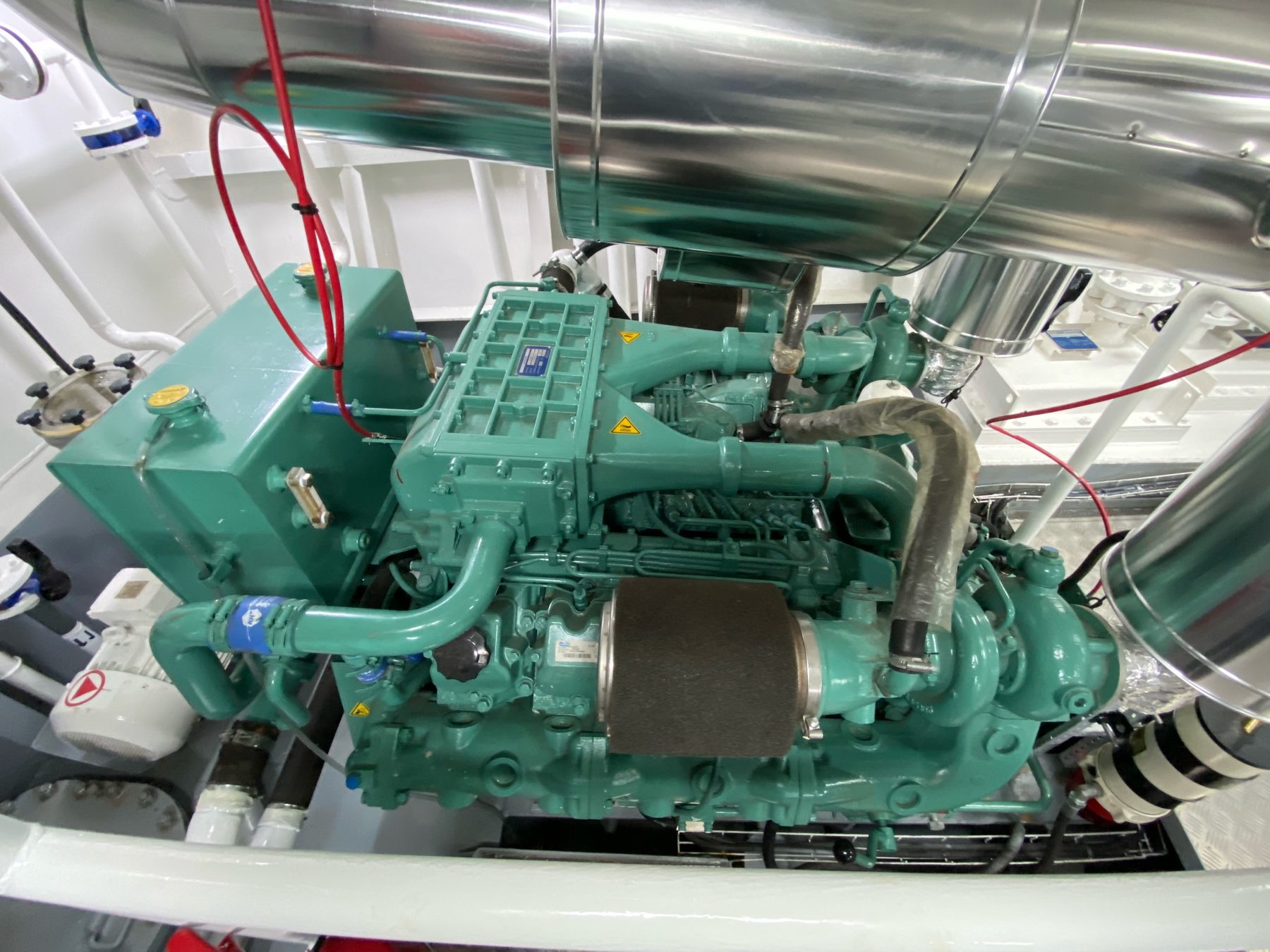
Auxiliary machinery. Generators, compressors, pumps, purifiers and other auxiliary equipment have maintenance intervals defined by operating hours. Periodic oil analysis is a simple, cost-effective tool that detects abnormal wear, contamination or lubricant degradation before they cause mechanical failure.
The role of NDT in preventive maintenance
Non-destructive testing (NDT) is the tool that transforms preventive maintenance from a fixed-calendar activity into a strategy based on the vessel’s actual condition.
Thickness measurement (UT) is the backbone of the piping and structural inspection programme. It quantifies wall loss in pipes, hull plates, bulkheads and tanks without cutting or dismantling anything. Results feed directly into decision-making: replace now, monitor at the next inspection, or defer until the next docking.
Weld inspection (RT, LP, MP). Existing welds — both original and from previous repairs — can develop defects over time: fatigue cracks, lack of fusion, porosity. Radiography (RT), liquid penetrant (LP) and magnetic particle (MP) testing detect these defects without destroying the weld.
Vibration analysis. In rotating machinery (engines, generators, pumps, compressors), vibration analysis detects misalignment, imbalance, bearing wear and other mechanical problems at early stages, when intervention is simple and inexpensive — not after the equipment has already failed.
Infrared thermography. In electrical systems, thermography identifies loose connections, overloads, degraded components and hot spots that are precursors to failure. It is a fast, non-invasive inspection that can be carried out with the system in operation.
The point is not doing NDT for its own sake. It is integrating results into the shipowner’s decision-making: what to repair at the next port call, what can wait until docking, what needs urgent intervention, and what is safe to continue operating. At SYM Naval, technical planning, QA/QC documentation and NDT are managed in an integrated manner, providing the shipowner with traceable, actionable information for every decision.
Documentation, class and traceability
A preventive maintenance programme that doesn’t generate traceable documentation is an incomplete programme. Not for bureaucratic reasons — for practical ones.
Accumulated maintenance documentation allows the shipowner to demonstrate to the class society that the vessel has been maintained to standards, justify to the insurer that due diligence has been exercised, facilitate certificate renewals with a complete technical history, make informed decisions about future repairs based on each system’s actual evolution, and negotiate charter contracts more effectively by demonstrating the vessel’s technical condition.
Every intervention — however small — should generate a record: what was done, who did it, with what materials, under what procedure, with what result and with what approval (where class supervision applies).
ISO 9001 (quality) certification provides the management framework to make this happen systematically. At SYM Naval, the integrated management system (ISO 9001, 14001 and 45001) ensures that every intervention produces traceable documentation, from material certificates to final NDT reports.
How to structure a maintenance plan with an external partner
Not every shipowner has an in-house technical department capable of planning and executing all maintenance. Many — particularly medium-fleet operators, regional shipowners or port companies — need an external partner bringing the technical capacity, infrastructure and geographic coverage they lack.
What a shipowner should expect from that partner is a technical assessment of the vessel’s actual condition as a starting point, a maintenance plan proposal with defined scope, timeline and budget, the ability to execute work in different modes (afloat, underway, at anchor, in dock) as appropriate, complete and traceable class documentation at every intervention, direct coordination with the class society surveyor, and a technical counterpart who speaks the superintendent’s language — literally and figuratively.
At SYM Naval, this is the standard way of working. Technical planning, execution with class-qualified welders and technicians, QA/QC documentation and coordination with major classification societies (DNV, ABS, LR, BV, RINA, NK) are part of the standard service. Bilingual supervision (Spanish/English) facilitates coordination with shipowners, inspectors and international surveyors. And the base network — Vilanova i la Geltrú (Barcelona), Boca Chica (Dominican Republic) and Panama City — delivers coverage across the Mediterranean, Caribbean and Canal corridor without reliance on third parties.
The aim is not to create dependency, but to give the shipowner the confidence that their vessel is technically managed by a team that knows the ship, knows the deadlines and knows the class requirements.
FAQ — frequently asked questions about preventive ship maintenance
How often should I inspect my vessel’s piping? Depends on circuit type and operating environment, but as a general reference, ballast, bilge and seawater lines should undergo ultrasonic thickness measurement at least every two to three years, or more frequently where previous findings exist. Fuel lines and pressure circuits may require different intervals according to class rules.
Can preventive maintenance be done without dry docking? Yes, a significant portion can be carried out afloat, underway or at anchor. Piping, mechanical, electrical work, topside coatings and machinery overhauls don’t require docking. What does need docking (or beaching) is underwater hull work: inspection and treatment of the hull, propeller and shaft review, anode replacement and rudder repair.
What does a good pre-docking inspection include? A hull inspection (visual and, where possible, underwater), thickness measurements in identified critical zones, piping condition assessment by system, propulsion and steering equipment review, and electrical and safety system checks. The output should be a documented technical scope with drawings, material lists and budget.
How much can I save with a preventive programme versus emergency repairs? No universal figure, but industry experience indicates that emergency repair costs can be three to five times higher than the same intervention planned — in direct costs alone (excluding off-hire). When off-hire is included, the difference multiplies. A propulsion failure generating 10 days of off-hire on a vessel earning USD 15,000–25,000/day in freight has an impact far exceeding the cost of a preventive inspection campaign.
What certifications should the maintenance team hold? Welders and technicians must hold current qualifications from the vessel’s class society for the processes and materials they’ll use. The company should hold ISO 9001 (quality), ISO 45001 (safety) and ideally ISO 14001 (environment). It must also demonstrate documented QA/QC, NDT and work permit procedures.
How do I coordinate preventive maintenance with class inspections? Ideally, the preventive plan is designed with the class inspection calendar in mind (annual, intermediate, special survey). This way, preventive work is carried out ahead of inspections, avoiding class findings that generate delays or additional conditions. Surveyor coordination should be planned from the start of each intervention, not resolved on the fly.
Want to structure a preventive maintenance plan for your vessel or fleet?
At SYM Naval we plan and execute maintenance programmes tailored to each vessel type, route and operating condition. We assess structures, systems and critical components, optimising stop cycles and extending equipment service life. With teams available 24/7, bases in the Mediterranean, Caribbean and Panama, and ISO 9001, 14001 and 45001 certifications.
→ Contact our technical team → Explore our ship repair services