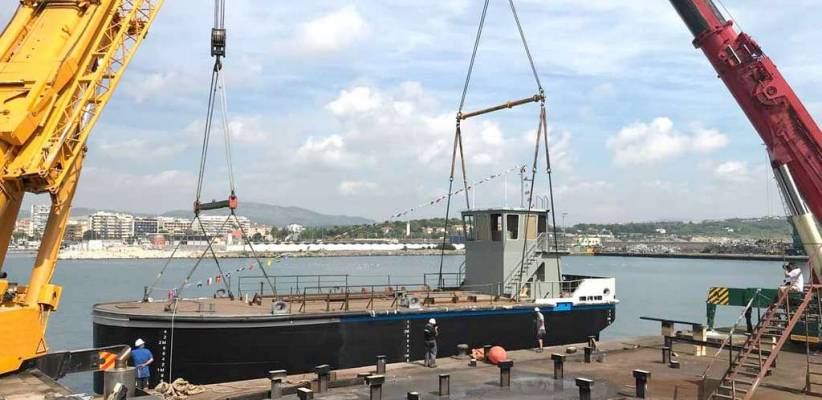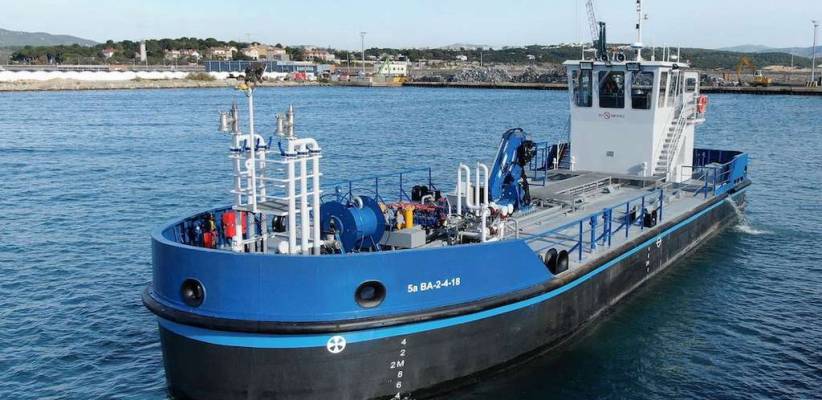
A shipowner who needs to cut emissions across an operating fleet faces two separate decisions. The first is to establish whether the operation can support a fully electric solution. The second, if the answer is yes, is to choose between converting the existing vessel or replacing it with a newbuild.
The order matters. A hull in good condition does not by itself make a vessel a retrofit candidate, just as a new unit does not solve an operation that lacks sufficient range or shore charging infrastructure. The decision should move through filters: operation, marine integration, approval, and cost over the service life.
If the question is still which power train to choose — diesel, hybrid or fully electric — we cover that in electric propulsion in harbour vessels. Here we start from a different scenario: the vessel already exists and a decision has to be made about it.
First filter: can the operation support electrification?
Before studying where to place the batteries, the vessel’s operation has to be translated into energy and power. The decisive figure is not a generic catalogue range, but the real working profile.
The analysis starts with these variables:
- Duty cycle: hours under way, manoeuvring, standby and auxiliary services.
- Energy demand: daily consumption and energy required between two charging opportunities.
- Power peaks: maximum demand during towage, manoeuvring, pumping or other operations.
- Charging windows: time available alongside and how often the vessel returns to its base.
- Shore power: actual capacity of the grid and of the connection point.
- Required availability: whether the vessel can be stopped to charge, or must remain continuously operational.
If the required energy does not fit on board without compromising stability, payload or mission, a newbuild does not automatically make the operation viable either. The outcome may be a hybrid solution, a change in service planning, or the conclusion that electrifying that unit is not yet worthwhile.
Once this first filter is cleared, comparing retrofit and newbuild starts to make sense.
Second filter: is the existing vessel a good candidate?
A retrofit study begins with the vessel, not with the battery system. You need to know the asset, its documentation and the work it will have to keep performing after the conversion.
| Filter | What is checked | What may rule out the retrofit |
|---|---|---|
| Condition and remaining life | Structure, corrosion, outstanding repairs and service horizon | Major structural renewal or few years of useful life left |
| Operational fit | Whether the vessel still suits its future mission | Change of mission, capacity, bollard pull, speed or availability |
| Weight, volume and stability | Battery location, reinforcements, centres of gravity and payload | Excessive operational loss or inability to meet stability criteria |
| Safe integration | Battery space, cooling, ventilation, fire protection and maintenance access | Disproportionate rework of the general arrangement |
| Existing systems | Propulsion, switchboards, cabling, control, auxiliaries and steering | Replacing so many systems that the retrofit advantage disappears |
| Class and flag | Applicable rules, documentation and scope of approval | Requirements incompatible with the budget or the available stoppage |
| Project economics | Investment, off-hire, operation, future batteries and residual value | Lifecycle cost higher than that of a new unit |
These factors are not added up as votes. One critical limitation can outweigh six favourable results. That is why the purpose of the first engineering stage is not to confirm a decision already taken, but to identify early any condition that invalidates it.
When an electric retrofit may be the better option
A retrofit is worth studying when the asset still holds value and the problem is concentrated in the propulsion or in its environmental impact.
The starting conditions are usually better when:
- Hull and structure are in good condition.
- Enough years of service remain to amortise the investment.
- The vessel’s mission will remain essentially the same.
- The operating profile supports the required range and charging.
- Batteries and their auxiliary systems can be integrated without an unacceptable loss of capacity.
- The scope can be approved and executed within a stoppage compatible with the operation.
- There are several sister vessels and the engineering from a first conversion can be reused.
In that scenario, a retrofit may preserve value, reduce the initial investment and avoid the full design and construction lead time of a new unit. These are not automatic advantages: they depend on the structural scope, the equipment that has to be replaced and the time out of service.
When a newbuild may be the better option
A newbuild becomes more compelling when the conversion requires so much redesign that it is no longer a modernisation.
It is worth seriously comparing a newbuild when:
- Steel renewal or other significant structural repairs are outstanding.
- The remaining useful life is insufficient to recover the investment.
- The arrangement does not allow a safe space for batteries and auxiliary equipment.
- The installed weight reduces payload too much or alters stability.
- The future mission requires more capacity, power, speed or range.
- The conversion requires replacing propulsion, electrical distribution, auxiliaries and large areas of the general arrangement.
- The owner needs a new standardised series for a different operation.
A newbuild starts from a blank sheet. It allows hull forms, weights, subdivision, cable routing, cooling and maintenance to be optimised from the first design. The trade-off is a higher initial investment and a delivery lead time that must also be built into the comparison.
What an electric retrofit actually requires
Converting a vessel is not a matter of removing one engine and installing another. Propulsion, energy storage, electrical distribution, thermal management and control form a single system.
The project must address at least these areas:
- Vessel survey and documentation. Drawings, general arrangement, stability information, electrical diagrams, consumption data and the condition of existing equipment.
- Energy sizing. Energy per cycle, peak power, reserve margin, expected degradation and charging strategy.
- Weight and stability. Battery location, reinforcements, centres of gravity and the effect on operational capacity.
- Battery safety. Cooling, ventilation, detection, containment, accessibility and response to an incident.
- Electrical and mechanical integration. Switchboards, protections, cabling, propulsion, steering, auxiliary systems and energy management.
- Shore charging. Available power, interface, connection times and the works required ashore.
- Class and flag. Concept review from the outset, drawing approval, surveys and testing.
- Execution plan. Engineering, procurement, prefabrication, work on board, possible dry-docking, commissioning and sea trials.
A modular architecture makes the system easier to adapt, but it does not by itself remove the vessel’s physical constraints. Access routes, compartments, supports or structure may still need modification. That is precisely what the preliminary study has to determine.
Lifecycle cost: comparing more than two quotations
The price of the works is not enough to decide. An apparently inexpensive retrofit can stop making sense if it requires a long stoppage, reduces the vessel’s capacity or needs a second structural investment a few years later.
The comparison must be made over an equivalent horizon:
| Item | Retrofit | Newbuild |
|---|---|---|
| Engineering and approval | Survey, redesign, class and flag | Full design, class and flag |
| Main investment | Works, equipment, integration and possible reinforcements | Construction and outfitting of the new unit |
| Shore infrastructure | Charging and possible grid reinforcement | Charging and possible grid reinforcement |
| Operational impact | Time out of service and possible loss of capacity | Delivery lead time and interim solution until handover |
| Operation and maintenance | Energy, maintenance and systems that remain on board | Energy and maintenance of an optimised architecture |
| Batteries | Replacement expected within the remaining life | Replacement expected over a longer service life |
| End value | Residual life and value of the converted vessel | Full service life and residual value of the new unit |
The result can be expressed as total cost of ownership or present value over the chosen period. What matters is including the same items and the same horizon in both alternatives.
An example of why the horizon changes the conclusion: a moderately priced retrofit on a hull with six years of service left can work out more expensive per year of operation than a new unit with twenty years ahead of it, even though its budget is a fraction of the construction cost. And the other way round: on a sound hull with two decades of remaining life, the same retrofit is usually hard to beat. The figure that decides is not the price of the works, but what each year of service bought with it costs.
The decision does not always end in two options
An honest study can lead to four outcomes:
- Fully electric retrofit: mission, vessel and infrastructure are compatible.
- Hybrid retrofit: the operation needs more range or availability than a battery-only solution allows.
- Electric newbuild: the mission can be electrified, but the existing vessel does not allow reasonable integration.
- Do not convert yet: neither the operation nor the infrastructure justifies the investment today.
Defining these possible outcomes from the start avoids forcing a technical solution that does not fit the asset.
Planning a fleet: pilot, repetition and service continuity
Where several units are involved, the decision should not be taken vessel by vessel without a common sequence.
A first unit can act as a pilot project to validate engineering, consumption, charging, works duration and crew procedures. If the fleet includes sister vessels, that experience can be reused and reduce the effort of subsequent conversions.
The fleet plan must also coordinate:
- Shipyard and equipment availability.
- Class and flag review.
- Grid reinforcement and charging points.
- Crew training and maintenance.
- Units that remain in service during each intervention.
- The point at which it is better to stop converting and start renewing.
The order of the interventions can have as much economic impact as the technical decision on each vessel.
How SYM Naval can be involved
SYM Naval brings together three capabilities relevant to studying both routes:
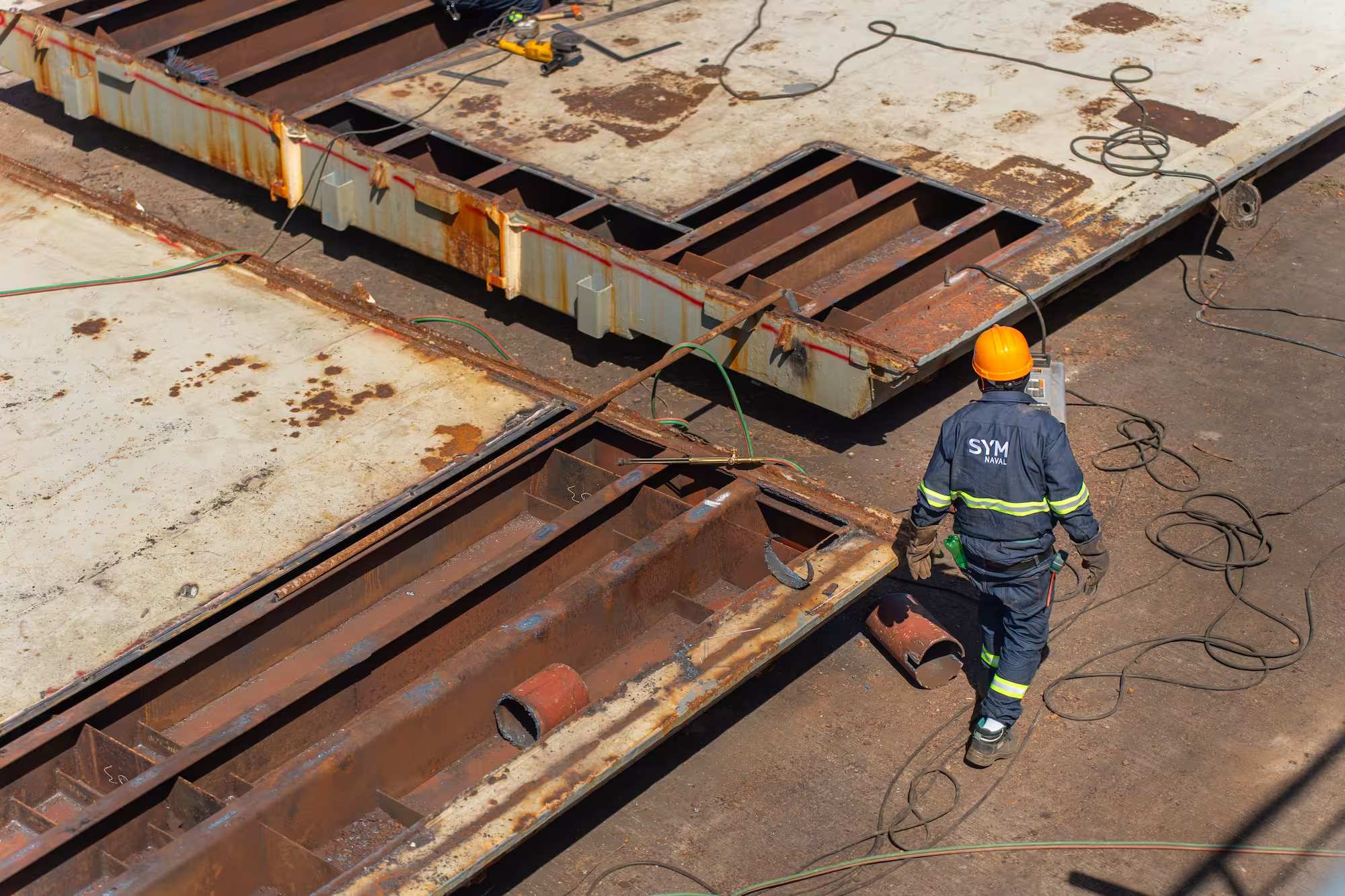
- Ship conversion. The technical office analyses structural modifications, stability, cargo changes and propulsion upgrades, and coordinates projects with shipyards and classification societies. More information on ship conversion.
- Electric propulsion. Blu-e Propulsion is SYM Naval’s own system, based on LFP batteries and a modular architecture with energy management, cooling and redundant configurations tailored to each project.
- Newbuilding and preliminary engineering. SYM Naval designs and builds custom vessels and uses the digital mock-up to validate arrangement, equipment and clashes before fabrication begins.
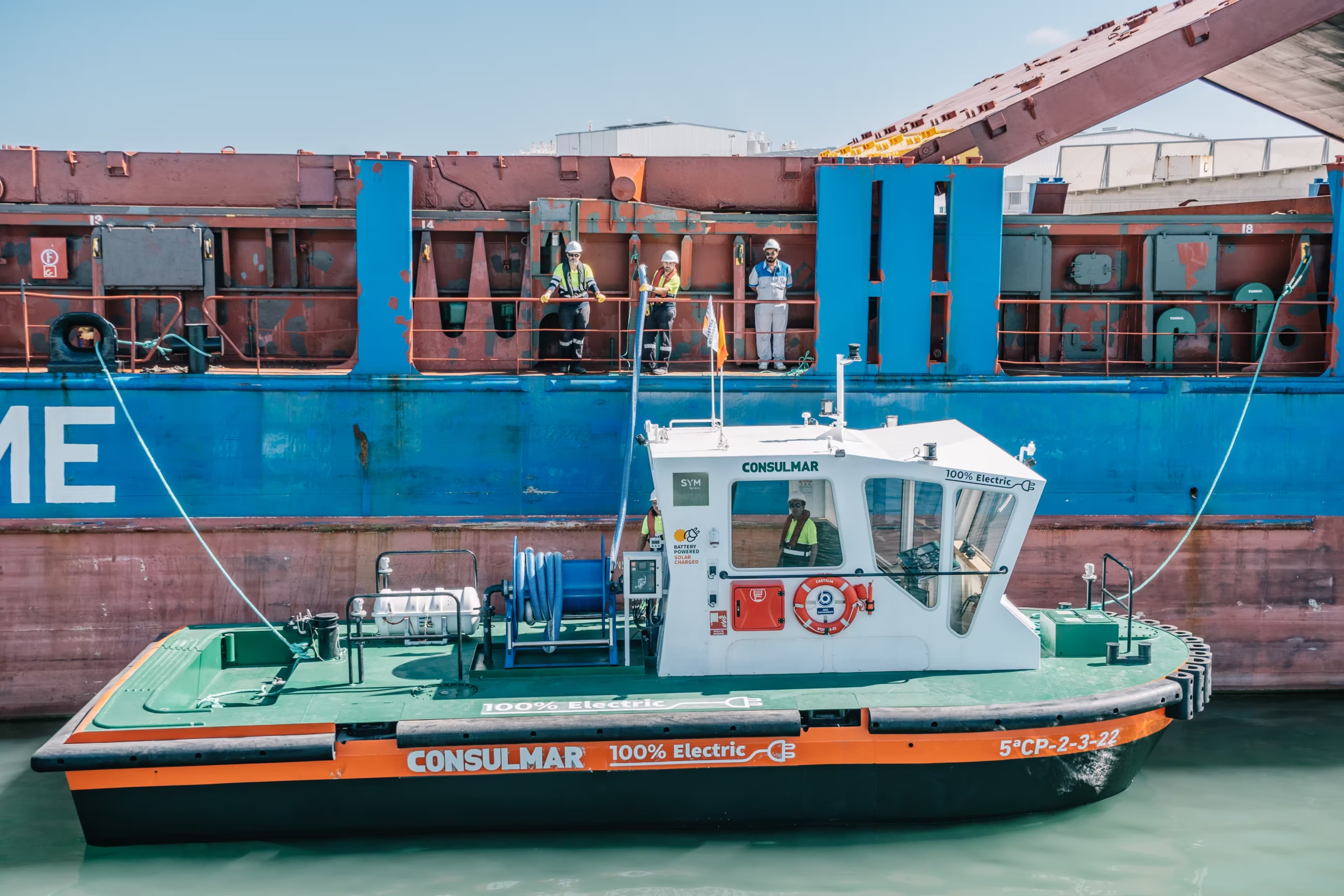
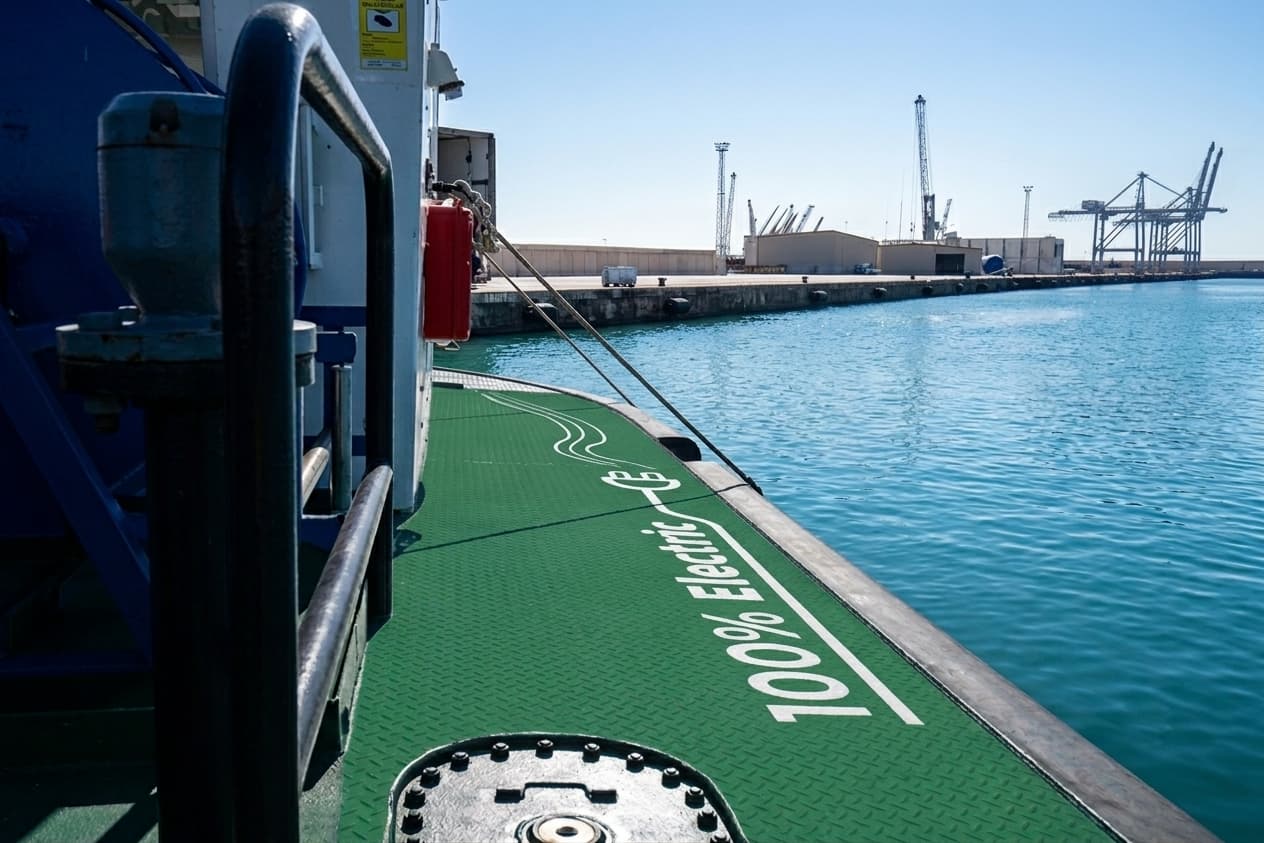
At SYM Naval, electrification is already part of our work. We have developed and delivered Spain’s first fully electric tug and continue to apply that experience to new vessels and marine electrification solutions. This experience comes from newbuild projects rather than retrofits and gives us direct knowledge of onboard electrical engineering and integration.
We combine that experience with our ship conversion capabilities to assess both routes from the same starting point: the work the vessel must perform. From there, we help the owner determine whether to convert the existing unit, adopt a hybrid solution or commission a newbuild.
Frequently asked questions
Can any vessel be converted to electric propulsion?
No. The operation must be compatible with the available energy, and the vessel must accommodate the batteries and auxiliary systems without compromising stability, safety or mission.
Does a retrofit always cost less than a new unit?
Not necessarily. It may require a lower initial investment, but the comparison must include engineering, approval, infrastructure, off-hire, future batteries, remaining life and residual value.
Does an electric retrofit require dry-docking?
It depends on the scope. Engineering and part of the prefabrication can be carried out before the stoppage, but modifications to propulsion, structure, shafts or sea chests may require dry-docking. The feasibility study must determine this.
How long does the conversion take?
It cannot be estimated from the vessel type alone. It depends on the redesign, the approval process, equipment availability, structural works and the testing plan.
What range will the vessel have after the retrofit?
Whatever results from the operating profile, the installable capacity and the charging strategy. If the mission demands long range or continuous availability, a hybrid solution may be more suitable.
Does a fleet of identical vessels favour retrofit or newbuilding?
It can favour either. In a retrofit it allows engineering to be reused after a pilot unit; in newbuilding it allows the development of an optimised series to be spread across the fleet.
Preliminary assessment
To judge whether it is worth starting a study, the minimum required is:
- Vessel type, main dimensions and year of build.
- Latest class or statutory survey reports.
- Daily operating profile and, where available, consumption or engine load data.
- Home port, stoppage windows and known connection power.
The general arrangement and stability information will allow progress towards a technical assessment later. These first data points do not close the decision, but they do show whether there is a reasonable basis for studying the retrofit.
If the vessel operates on rivers or canals, the assessment starts from the inland navigation profile: hulls that last for decades and regulatory pressure that does not come from the condition of the vessel. We explain it in inland fleet electrification.
Write to us at comercial@sym-naval.com with the information available and our team will review the starting point.